
What is a flat chastity cage?
A flat chastity cage is a male chastity device whose cage is very short and ends in a flat front plate instead of a longer tube. It locks to a ring worn around the base of the penis and behind the testicles, holding the penis close to the body, with a small opening in the plate for urine.
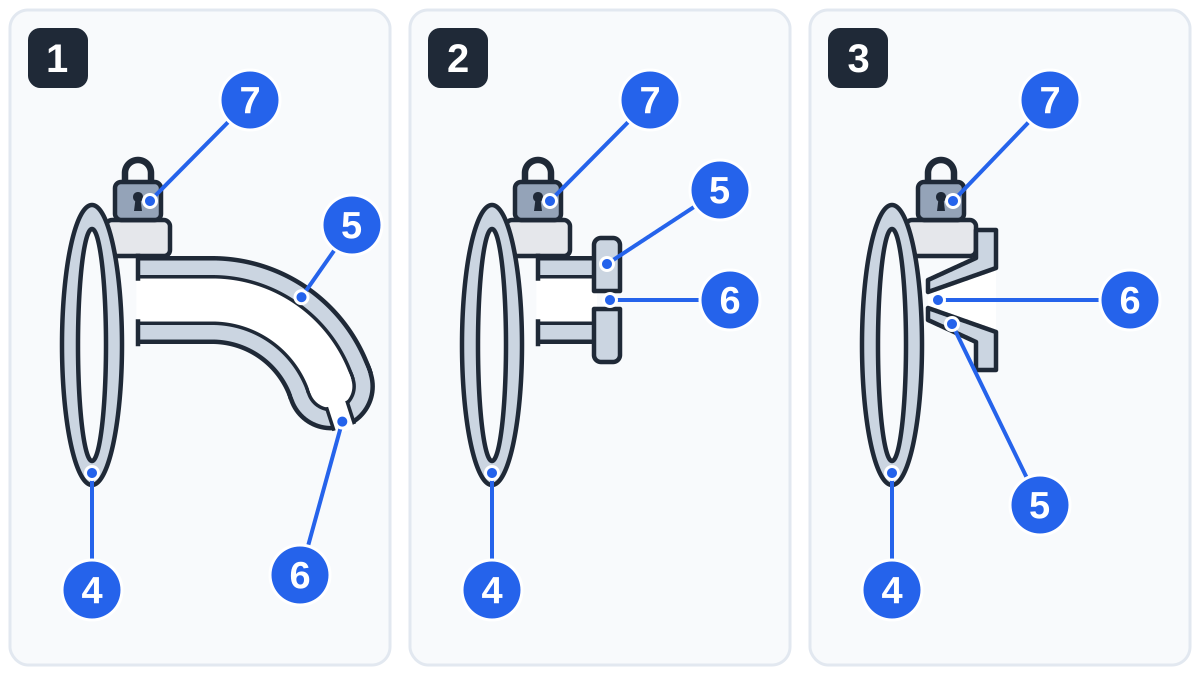
Product names are not standardized. "Flat" usually means the cage ends in a flat face a short distance in front of the base ring. "Inverted" or "negative" usually means the cage recedes inward toward the body, and some listings combine the words as "inverted flat". Very short tubes are also sold as "nub" or "micro" cages. Judge a device by its side profile and its stated internal length, not by its name.
How does a flat chastity cage work?
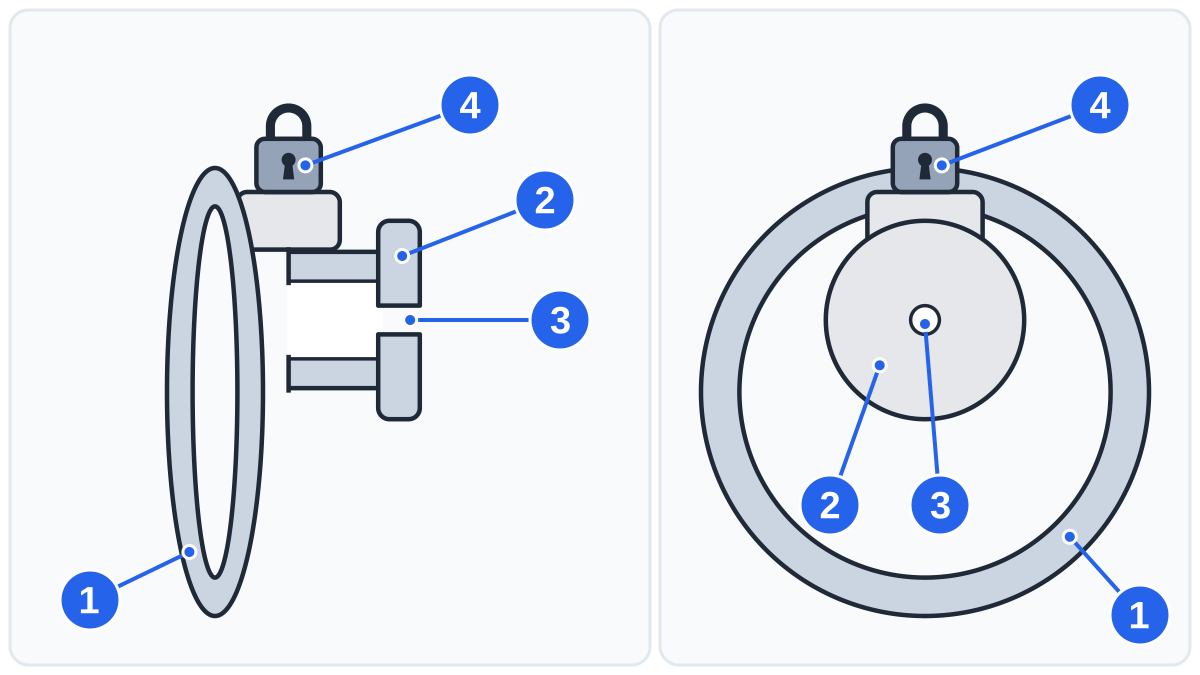
A flat cage has the same basic parts as other chastity cages. A 2026 expert-opinion article in The Journal of Sexual Medicine describes these devices as worn around the penis, often with a base ring positioned behind the scrotum.
- Base ring. A closed ring around the base of the penis and behind the testicles. It anchors the device: while the ring and cage are locked together, the cage cannot be pulled off.
- Short cage with a flat front plate. The cage is much shorter than a standard tube and is closed at the front by the plate. The penis rests inside, held back toward the body.
- Opening. A hole in the plate lets urine out. It needs to line up with the urethral opening.
- Lock. A small padlock, a built-in lock or a numbered plastic seal joins the ring and cage. Some designs add spacers that set the gap between them.
A cage does not stop an erection from starting; it stops it from completing. The same article notes that wearing these devices prevents full erections. A flat cage has very little room inside, so swelling or an erection meets the front plate sooner than it would in a longer tube. That is the main practical difference between a flat cage and a longer one.
Flat vs standard vs inverted chastity cages
All three designs use a base ring and a lock; they differ in what sits in front of the ring. The standard design, sometimes simply called a normal cage, has a tube that extends forward.
| Feature | Standard (curved) cage | Flat cage | Inverted cage |
|---|---|---|---|
| Shape in front of the ring | A tube that extends forward, often curving downward | A short cage closed by a flat plate | A short tube that recedes inward toward the body |
| Space inside | The most | Little | Little, shaped inward |
| Where the opening sits | At the tip of the tube | In the front plate | Inside the recess, closer to the body |
| Outline under clothing | The most visible | Lower | Usually the lowest |
| What an erection presses against | The walls and tip of the tube | The front plate | The inward-shaped tube |
| What to check first | Tube length, width and curve | Internal depth and the position of the opening | How deep the recess is and where it presses |
If a listing says "inverted flat", look at the side profile: if the opening sits inside a recess, the device works more like an inverted cage. Our inverted chastity cage guide explains that design, and the overview of types of chastity cages covers other styles.
Benefits and drawbacks of a flat cage
People choose flat cages mainly for their compact shape. The same shape causes most of the drawbacks.
Possible benefits
- A lower outline under close-fitting clothes than a long tube. It is not invisible: body shape, ring size and clothing all make a difference. See our guide to chastity cages and clothing.
- Less of the device sticks out, so there is less to swing, catch or press against clothing.
- Some people prefer the look, or what it symbolizes in a consensual arrangement with a partner.
Drawbacks
- Very little room inside, so pressure from swelling or an erection comes sooner and is felt against the plate.
- The fit has to be close. A cage that is too short presses all the time; one that is too deep lets the penis move back toward the ring, where skin can be pinched.
- The plate covers the head of the penis closely, so moisture stays against the skin, and the skin cannot be washed without taking the cage off.
- The opening has to line up well, or urine can spread or collect inside.
A flat cage restricts erections more tightly than a longer tube. For some wearers that is the point; for others it is the reason a flat design does not suit them. Whatever the reason for wearing one, the wearer should be able to stop and take it off at any time.
Flat cage design and materials
Two flat cages can look alike in photos and behave very differently. Check these details before choosing one, and ask the maker if they are not listed:
- Internal depth: the usable space between the ring and the inside of the front plate. With so little space, small differences in depth change how the cage presses.
- Ring options: the diameters and shapes on offer, such as round or oval, measured on the inside, and whether spacers let you adjust the gap between ring and cage.
- Opening: its size and position on the plate, and whether it lines up for you.
- Edges and surfaces: every edge that touches skin, including the rim of the cage and the edge of the opening, should be rounded and smooth, with no seams, burrs or rough print lines.
- Ventilation: slots let air in and water through, but rinsing does not replace taking the cage off to wash and dry the skin.
- Lock and release: how it locks and how quickly it opens. The wearer should be able to reach the key or release at all times.
- Weight: a heavier device pulls more on the ring as you move.
Flat cages come in the same materials as other cages. The finish of the actual product matters as much as the material name.
| Material | What to expect | What to check |
|---|---|---|
| Stainless steel | Rigid and heavy for its size; can be polished smooth | Total weight, weld seams, and the exact alloy if you react to metals |
| Titanium | Rigid and much lighter than steel | The finish around the edges and the lock |
| Moulded plastic | Light and rigid | Seams from the mould, especially around the plate and the opening |
| 3D-printed resin | Light; can be made in custom shapes and sizes | Smoothness inside the cage, print lines, cracks, and which resin is used |
| Silicone | Soft and flexible | Whether the plate holds its shape and the opening stays in place |
If you have reacted to metal jewellery, ask which alloy is used: the NHS notes that some metals, including nickel, can trigger allergic contact dermatitis. Labels such as "medical grade" or "body-safe" describe a material; they do not show that a finished device suits long wear. Our materials comparison covers each material in more detail.
This guide describes flat cages in general and does not test or rank products.
Fit and sizing: can anyone wear a flat cage?
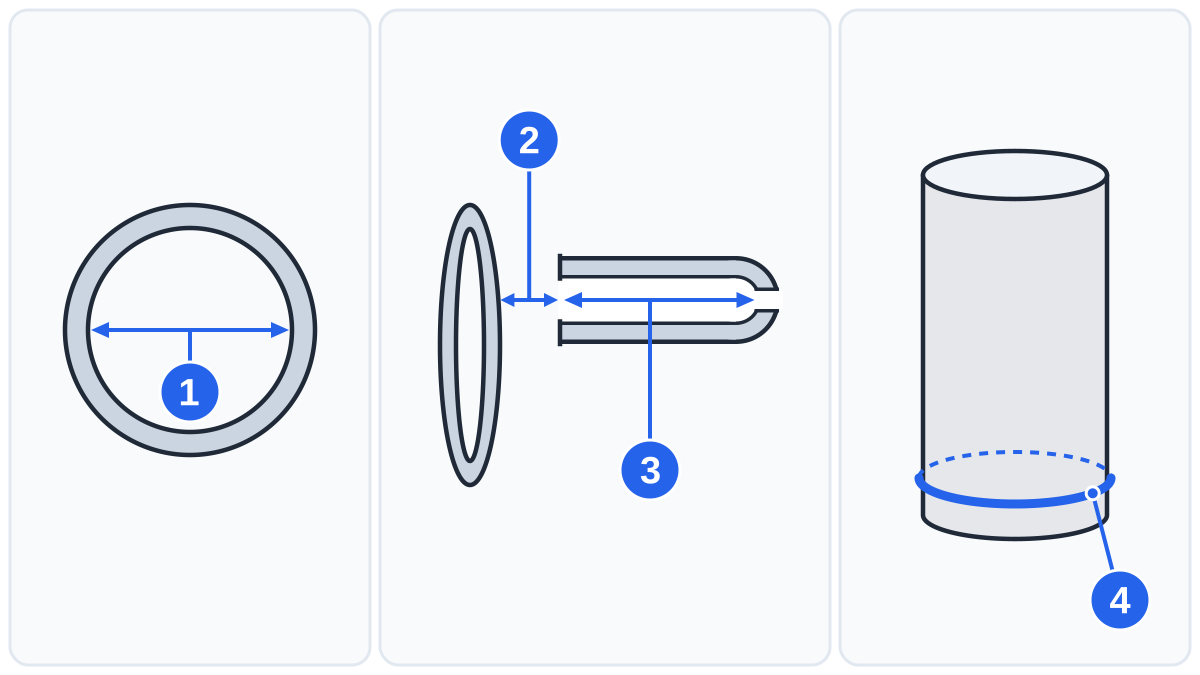
Not everyone can wear a flat cage comfortably. Because the cage is so short, it has to suit your anatomy closely, and there is less room to correct a poor fit than with a longer tube. If a flat cage presses constantly while you are relaxed, it is the wrong size or the wrong design for you: try a different size, or a design with more room inside.
Compare the maker's size chart with your own measurements, and ask how the maker measures: a ring or cage can be measured inside or outside, and across a round or an oval shape. Our sizing guide explains each measurement and what it cannot tell you.
- Ring too small: it squeezes the base of the penis, and anything that constricts there can trap swelling (see the risks below). Never use a ring you have to force on.
- Ring too large: the cage can pull forward and the penis can slip back out.
- Cage too short: constant pressure against the front plate.
- Cage too deep: more movement, and skin can be caught in the gap.
If you have a condition that affects sensation, circulation or the foreskin, or you have had genital surgery, talk to a clinician before trying any chastity device.
Putting on a flat cage
Our step-by-step guide to putting on a chastity cage covers flat, inverted and standard designs with diagrams. In outline:
- Fit the base ring around the base of the penis and behind the testicles, without forcing anything through it.
- Position the cage so the penis rests inside and the hole in the plate lines up with the urethral opening.
- Bring the ring and cage together and insert the lock, checking that no skin is folded at the edges of the plate or caught in the gap.
- Check the fit: no pinching or pain, you can pee through the opening, and the key is within reach.
If you have a foreskin, leave it in its usual position over the head of the penis. A foreskin that gets stuck pulled back can leave the end of the penis very swollen and painful; the NHS calls this paraphimosis and treats it as a medical emergency.
Flat chastity cage risks
A flat cage carries the risks of any chastity device, plus extra pressure from its short design: a ring that constricts, pressure and pinching at the edges, skin irritation from trapped moisture, urine that does not drain cleanly, and pain from erections. Its long-term effects on health are unknown.
No study has followed people who wear chastity devices over time. The 2026 Journal of Sexual Medicine article states that male chastity devices "have not been evaluated in clinical or epidemiologic studies". Its authors discuss possible effects of long wear on the prostate and testicles only as hypotheses; they are questions, not findings. No one can say how long a flat cage can safely be worn, and this guide does not suggest a wearing time.
The closest medical evidence comes from case reports of penile strangulation, where a ring or other object around the penis cannot be taken off. An object that constricts the penis stops blood and lymph from draining, so the tissue beyond it swells, and the swelling can lock a metal ring in place (Dhamor and colleagues, 2025). A 2008 review in The Journal of Sexual Medicine found that metal rings are the most commonly reported cause, that people often reach hospital only after several days of swelling, and that most do extremely well when the object is removed quickly. These reports are not about chastity cages, but a cage's base ring sits around the same part of the body.
Risks to know about with a flat cage:
- Constriction at the ring. A ring that is too small, or swelling while the cage is on, can restrict blood flow. This is the risk with the most serious possible outcome.
- Pressure and pinching. With so little room inside, swelling or an erection presses on the plate sooner than in a longer tube. Skin can also be caught in the gap between ring and cage, or rub on the rim of the cage and the edge of the opening.
- Trapped moisture and urine. Sweat and urine can stay against the skin under the plate, especially if the opening does not line up. The NHS lists not washing the penis properly, and irritants such as soap and shower gel, among the causes of balanitis, a swollen and sore head of the penis.
- Erections during sleep. Healthy men have erections during REM sleep that are not under their control (Hirshkowitz and Moore, 1996), so a cage worn overnight will be pressed by them. There is no evidence on whether overnight wear is safe, and this guide does not recommend it.
Take the cage off straight away if you notice pain, swelling, a change in skin colour, difficulty peeing or skin caught in the device, or if anything else feels wrong. One case report describes a ring lodged at the base of the penis that caused pain, swelling, discolouration and blocked urine (Gazzah and colleagues, 2024).
Go to an emergency department (A&E in the UK) or call your local emergency number if the cage will not come off or the foreskin is stuck behind the head of the penis. Do not wait: swelling gets worse while a ring stays on, and the 2008 review found that people who reach hospital more than 72 hours after a ring becomes stuck are more likely to have more serious injuries than those treated sooner. The NHS also advises emergency care for testicle pain that is sudden and severe, comes with feeling or being sick, or has lasted more than an hour, and for an erection that lasts more than 3 to 4 hours (priapism). If pain or swelling has not settled soon after you take the cage off, get urgent medical advice.
This is general information, not a substitute for advice from a clinician. Our guide to chastity cage risks and long-term effects covers each risk in more detail.
Peeing and cleaning in a flat cage
You can pee while wearing a flat cage: urine leaves through the opening in the front plate. How cleanly it drains depends on how well the opening lines up, so check this when you first fit the cage, and dry the device as well as you can afterwards. Our page on using the toilet in a chastity cage has practical tips.
Rinsing through the opening or slots is not the same as washing. To clean the skin under the plate, take the cage off. For a swollen or sore head of the penis, the NHS advises washing every day with just water or an emollient, not using soap or shower gel, drying gently, and seeing a doctor (a GP in the UK) to find the cause; leave the cage off until the skin has settled. Clean the device itself with the method the maker gives for its material. Our hygiene guide explains the difference between skin care and device cleaning.
Frequently asked questions
Are flat chastity cages safe?
No chastity device has been studied for safety, so none has been shown to be safe. A flat cage adds pressure from its short shape. Wear one only if you can take it off at once, and stop at the first warning sign.
How long can you wear a flat chastity cage?
There is no evidence-based answer, and this guide does not give one. Take the cage off at any warning sign, to wash and dry the skin, and whenever you want to stop.
Can you sleep in a flat cage?
Erections happen naturally during sleep, and a flat cage leaves little room for them. Nothing shows that overnight wear is safe, and this guide does not recommend it.
Is a flat cage the same as an inverted cage?
No. A flat cage ends in a flat plate in front of the ring; an inverted cage recedes inward toward the body. Some products mix the two shapes, so check the side profile.
Does a flat cage show under clothes?
Usually less than a long tube, but it is not invisible. The ring, your body shape and the cut of your clothes all affect how much shows.