
Yes, you can pee while wearing a chastity cage. Urine leaves through an opening in the device, usually at the tip of the tube or in a flat front plate. That opening does not always line up with the urethra, so sitting down is the simplest way to keep spray in the bowl. Afterwards, blot or rinse, then dry.
This guide covers why cages spray, how standard, flat and inverted designs differ, how to clean up, and which symptoms mean the device should come off. It is general information, not medical advice. Male chastity devices have not been evaluated in clinical or epidemiologic studies (Wang and Raad, 2026), so the health guidance here relies on NHS advice and related research.
Why a chastity cage sprays or dribbles
Without a device, urine leaves the body in a single stream. In a cage, it first has to pass through the device's own opening. Spray and drips come down to a few mechanical causes:
- The openings do not line up. If the urethral opening sits to one side of the device's opening, the stream hits the inside wall, breaks up and escapes through bars, slots or gaps in several directions.
- There is empty space at the end of the tube. When the tube is longer than needed, urine collects at the end and can leak out sideways before it reaches the opening.
- The opening is small or partly covered. A narrow hole, or skin pressed against it, restricts the flow, so urine sprays or backs up inside the device.
- Urine stays in the device. Drops held in the tube and around the opening drip out after you finish, or later when you move.
Constant spray can be a sign of poor fit or positioning rather than something you are doing wrong. Compare the device's internal length and opening with the maker's sizing information (see our chastity cage sizing guide), and check how the cage sits using our guide on how to put on a chastity cage.
Standard, flat and inverted cages: where the urine goes
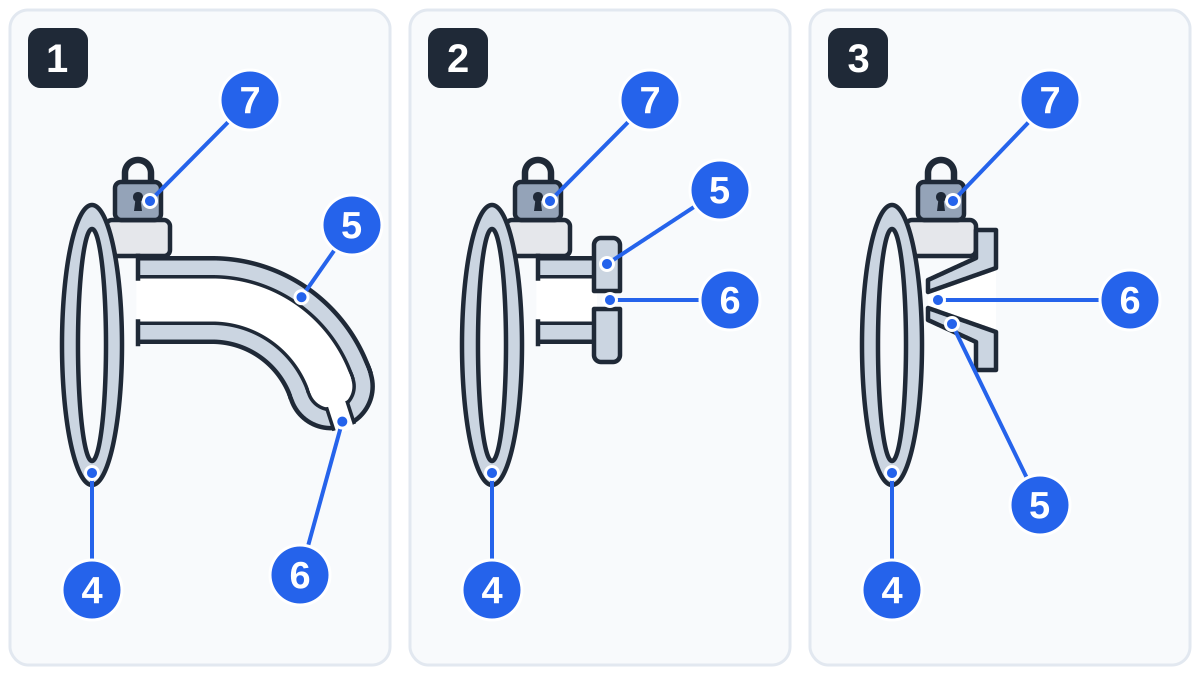
Where the opening sits in relation to the body decides how much control you have over the stream. Names and shapes vary between makers, so check the actual device rather than the label.
| Design | Where the opening sits | Usual cause of spray or drips | Sitting or standing |
|---|---|---|---|
| Standard (curved or straight tube) | At the tip of a tube that extends forward | Openings out of line; empty space at the end of the tube | Sitting is easiest; standing is possible if the tube can be angled down |
| Flat | In a flat front plate, close to the body | An off-centre stream hitting the plate | Sitting is usually more practical |
| Inverted (inward) | At the end of a short tube that points back toward the body | Urine running along the device and nearby skin | Sitting is usually more practical |
Standard cages
The tube extends forward from the base ring, often curving down, with the opening at its tip. Because the outlet sits away from the body, it can be angled down, so some people can pee standing up in this design. After peeing, tap out the drops and blot the tip.
Flat cages
A flat cage holds the penis in a short space behind a flat front plate, with an opening or a group of perforations in the plate. The outlet sits close to the body, so a stream that is slightly off-centre hits the plate and runs down; blot the plate and the skin below it afterwards. Read more about flat chastity cages.
Inverted cages
An inverted, or inward, cage uses a short tube that points back toward the body, so the opening sits much closer to the body than on a standard cage. Urine is more likely to run along the device and nearby skin, so sitting and careful drying matter most with this design. See inverted chastity cages explained, or our overview of types of chastity cages for other shapes and materials.
Should you sit or stand to pee in a chastity cage?
Sitting is the simplest option for every design. Sit well back on the seat, lean forward slightly and tilt the device so the opening points down into the bowl; any spray then stays in the toilet.
Sitting does not make peeing less effective. A 2014 systematic review found no difference in flow rate, voiding time or urine left in the bladder between sitting and standing in healthy men. In men with lower urinary tract symptoms, such as those caused by an enlarged prostate, sitting was linked to less urine left in the bladder (de Jong et al., PLoS One, 2014).
Standing is possible mainly with standard cages whose tube points forward and down. Hold the device rather than the skin around it, angle it down, stand close to the bowl and expect some spray until you know how your device behaves. With flat and inverted designs, standing tends to send urine along the device and onto skin or clothing.
Using public toilets and urinals
- Choose a cubicle (stall). You can sit, take your time and dry off in private. A urinal only works if your device lets you aim reliably.
- Carry tissues or unscented wipes for blotting. The NHS advises against using scented soap around the genitals (NHS).
- Allow extra time. Sitting, letting the device drain and blotting all take longer than peeing without a device. The NHS advises against rushing when you pee and recommends trying to empty your bladder fully (NHS: urinary tract infections).
- Keep drinking normally. Drinking less to avoid toilet trips works against NHS advice for preventing urinary tract infections: drink plenty of fluids, particularly water, so that you pee regularly, and do not hold your pee in when you feel the urge (NHS).
- Pack spare underwear for long days or travel, in case of drips.
Drying and hygiene after you pee
After each toilet visit:
- Let the device drain for a moment and tap it gently to release drops.
- Blot the opening and the outside of the device with toilet paper rather than rubbing.
- When you can, rinse with plain warm water (in the shower, with a bidet or with a squeeze bottle), then dry gently.
Drying matters because moisture and rubbing can irritate skin. A clinical review describes moisture-associated skin damage as skin inflammation caused by prolonged exposure to moisture, including urine and sweat, with chemical irritants, pH, friction and microorganisms all contributing (Gray et al., 2011). That review covers incontinence, skin folds, wounds and stomas, not chastity devices, but the same factors (moisture, urine and friction) are present inside a cage. The NHS also advises keeping the genital area clean and dry to help prevent urinary tract infections (NHS).
Rinsing through the bars is not the same as washing. The NHS self-care advice for balanitis, when the head of the penis is swollen and sore, is to wash every day with water or an emollient, gently pull back the foreskin and wash the area with warm water, dry gently and avoid soap or shower gel (NHS: balanitis). Return the foreskin to its normal position afterwards; one that stays pulled back and cannot return is an emergency (see the table below). None of this is possible through a locked device, so take it off to wash and dry the skin, and clean the device itself as its maker instructs. A smell that lingers after cleaning is a reason to remove the device and check the skin, not to cover it with fragrance.
When the device is off, check the skin wherever the device presses or rubs:
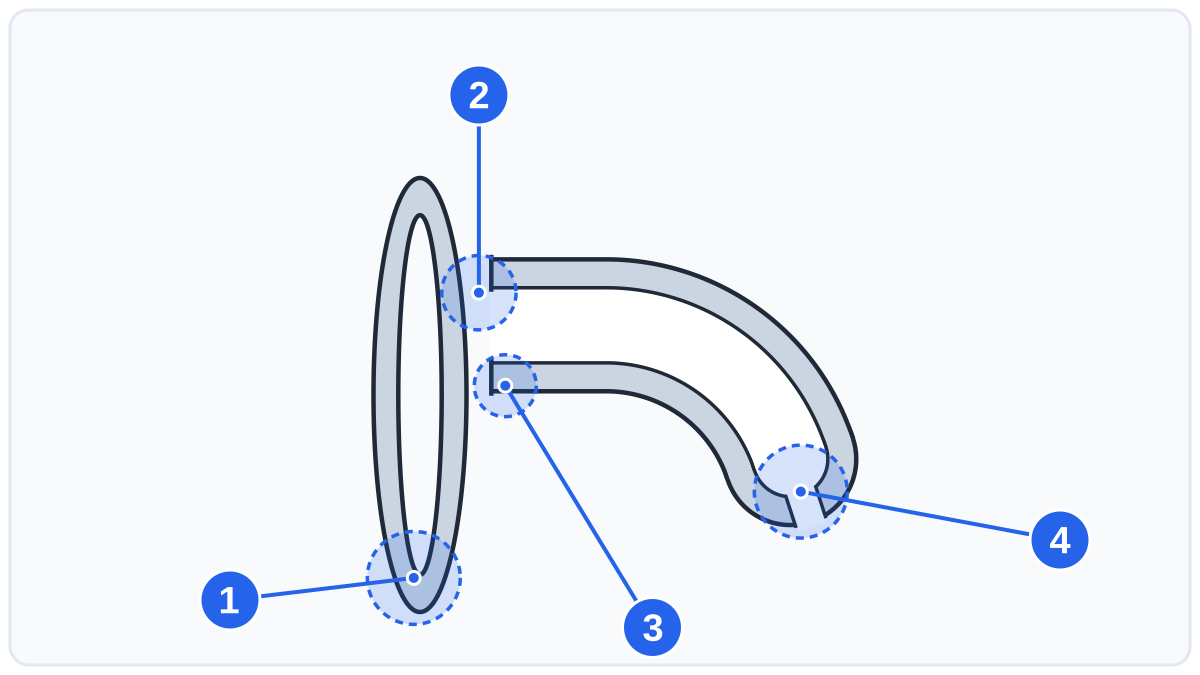
Redness, soreness or broken skin at any of these points is a reason to leave the device off until the skin has healed. For more detail, see why proper drying matters with chastity devices, our guide to chafing and pinching and our chastity hygiene guide.
Warning signs: when to take the cage off and get help
Spray and drips are a nuisance. The signs below are different, because they can point to an infection, a blockage or a device that is too tight. Keep the key or release where you can reach it yourself at all times, so taking the device off never depends on someone else.
Most of the advice in the table follows the UK's NHS. Where it mentions a GP (family doctor) or NHS 111 (the NHS urgent advice line), readers outside the UK should contact their own doctor or local urgent care service. For an emergency, go to an emergency department (A&E in the UK) or call your local emergency number (999 in the UK, 911 in the US).
| What you notice | What it can mean | What to do |
|---|---|---|
| Pain or burning when peeing, needing to pee more often or more urgently, cloudy pee, a high temperature or shivering, or pain in the lower abdomen or in the back just under the ribs | A urinary tract infection (UTI) | Take the device off and see a doctor urgently. The NHS advises men with UTI symptoms to ask for an urgent GP appointment or get help from NHS 111 (NHS). |
| Blood in your pee, even a small amount | It needs checking | See a doctor urgently; the NHS advises an urgent GP appointment or help from NHS 111 (NHS). |
| You cannot pee at all | The device may be pressing on or blocking the urethra, or there may be a problem with the bladder or prostate | Take the device off straight away. If you still cannot pee, get urgent medical help; the NHS advises an urgent GP appointment or help from NHS 111 (NHS). |
| Swelling, a change of colour, numbness, or a device that will not come off | Constriction (case reports: Sarkar et al., 2019; Weston and Golden, 2026) | Remove the device at once if it comes off easily. If it does not, go to an emergency department (A&E in the UK) straight away; a stuck ring around the penis is treated as a urological emergency (Silberstein et al., 2008). |
| The head of the penis is sore, itchy, red or swollen | Balanitis | Leave the device off and see a doctor (a GP in the UK) or a sexual health clinic (NHS). |
| The foreskin is pulled back and cannot return over the head of the penis | Paraphimosis, a medical emergency | Go to an emergency department (A&E in the UK) or call 911 in the US or 999 in the UK (NHS). |
| Sudden, severe pain in a testicle | A possible emergency | Go to an emergency department (A&E in the UK) straight away or call 911 in the US or 999 in the UK (NHS). |
The nearest medical evidence comes from case reports of rings and other objects stuck around the penis, and a chastity cage's base ring also sits around the base of the genitals, often behind the scrotum (Wang and Raad, 2026). In those reports, painful swelling and being unable to pee can occur together (Sarkar et al., 2019), and serious complications become more likely the longer removal is delayed (Zeid et al., 2022). Because of embarrassment, people often arrive only after a few hours (Sarkar et al., 2019), yet with rapid removal most patients do extremely well (Silberstein et al., 2008). Do not wait.
If you have difficulty peeing or need to pee more often even when the device is off, the NHS advises seeing a GP; elsewhere, see your doctor (NHS). Our guide to chastity cage risks and long-term effects covers what is and is not known about wearing a device.
Design features that make toilet visits easier
- An opening that lines up when the device fits. It should sit where urine leaves the body when the cage is correctly sized and positioned, not only when you hold it in place.
- An opening large enough to stay clear. A narrow hole is easily covered by skin and restricts the flow.
- The right internal length. Less empty space at the end of the tube means less urine collecting before it reaches the opening.
- No pockets where urine can pool. If the lowest part of the device has no opening, urine collects there.
- Smooth inside surfaces with few seams. Fewer crevices hold less residue and are easier to rinse.
- Open or enclosed, by preference. More open designs rinse and air-dry faster; more enclosed ones contain the stream better but stay damp longer.
- Fast removal by the wearer. A device you can take off yourself, at once, makes washing and any warning sign easier to deal with.
Frequently asked questions
Do you have to sit down to pee in a chastity cage?
No, but sitting is the simplest option for every design and keeps spray in the bowl. Standing works for some people with standard cages that point forward and down; flat and inverted designs are usually easier sitting.
Why does my chastity cage spray when I pee?
Usually because the device's opening does not line up with where urine leaves the body, the tube is longer than needed, or the opening is small or partly covered. Check the fit and position before deciding the design is at fault.
Can you use a urinal while wearing a chastity cage?
Sometimes, with a standard cage that you can angle downward. A cubicle is easier, because you can sit, take your time and dry off in private.
Can wearing a chastity cage cause a UTI?
This has not been studied: male chastity devices have not been evaluated in clinical or epidemiologic studies (Wang and Raad, 2026). NHS advice for lowering the risk of UTIs includes keeping the genital area clean and dry, drinking plenty of fluids and not holding your pee in. Men with UTI symptoms should see a doctor urgently (in the UK, an urgent GP appointment or NHS 111).
How do you clean a chastity cage after peeing?
Blot the opening and the outside with toilet paper, rinse with warm water when you can and dry gently. Take the device off regularly to wash and dry the skin, and clean the device as its maker instructs.
Does the same apply to chastity belts?
Broadly, yes. A belt's front shield has its own opening or perforated area, and sitting usually works best. Because a belt covers more skin, there is more to rinse and dry afterwards. See our chastity belt guide.
ChastityTek is developing its own device, Veru One; it is not yet available to buy.