
Chastity cages can rub, pinch and hold moisture against the skin, and a base ring that traps swelling can cause the kind of constriction injury doctors treat as a urological emergency. Chastity devices have not been evaluated in clinical studies, so it is not known whether long-term wear has lasting effects. The serious injuries on record involve rings and other objects trapped on the penis.
General information, not medical advice. This guide summarises the sources listed at the end; it has not been reviewed by a clinician and cannot assess your situation. Nothing in it shows that any device, design or length of wear is safe. If you have pain, swelling, numbness or a colour change now, go to the warning signs.
What the evidence says about chastity cage safety
Very little, and it helps to know how little. A 2026 expert-opinion article in The Journal of Sexual Medicine notes that "male chastity devices have not been evaluated in clinical or epidemiologic studies, leaving clinicians without clear guidance" (Wang and Raad, 2026). When this guide was written in October 2026, PubMed listed no trials, cohort studies or case series of chastity cage wearers.
The closest evidence is the medical literature on penile constriction, also called strangulation or entrapment: reports of rings and other objects stuck on the penis. None of the cases described here involved a chastity cage, but a cage's base ring often sits where several of those rings sat, around the base of the penis and behind the scrotum (Wang and Raad, 2026; Patel et al., 2018).
| Type of evidence | What exists | What it can and cannot tell you |
|---|---|---|
| Trials or long-term studies of cage wearers | None found | No safe wearing time, design or material has been established |
| Expert opinion | One article (2026) | Raises questions about prostate and testicular health; it is not a study of wearers |
| Case reports and reviews of penile constriction | Dozens of reports; one review of 100 cases | How constriction injuries develop and why fast removal matters, but not how often cage wearers are harmed |
| Personal accounts online | Plenty | Practical tips, but no measure of risk |
Two lessons apply to any device with a base ring. First, when a foreign object traps the penis, it "causes blockage of vascular and lymphatic channels leading to inflammation, edema, and ultimately necrosis" (Campbell et al., 2024), and once swelling sets in, a ring may not come off by hand (Kato et al., 2026). Second, people who sought help later were more likely to have severe injuries, while "with rapid intervention and removal of the foreign body, most patients do extremely well" (Silberstein et al., 2008), though "tissue injury may be severe and sepsis life-threatening, even after ring removal" (Patel et al., 2018). These findings describe an injury already under way, not how long a device can be worn.
Warning signs: remove the cage now
Pain is a reason to stop, not something to get used to. If any of these signs appears, unlock the device and take it off straight away. Where the table says emergency, go to an emergency department (A&E in the UK) or call your local emergency number, such as 911 in the US or 999 in the UK.
| Sign | What to do | Source |
|---|---|---|
| Pain, swelling, numbness, or a dusky or unusual colour, especially beyond the ring | Take it off now. Emergency if it will not come off, or if the symptoms continue once it is off. | Case reports: Weston and Golden, 2026; Patel et al., 2018 |
| Sudden, severe pain in a testicle; testicle pain with nausea, vomiting or abdominal pain; testicle pain lasting more than an hour | Emergency. A twisted testicle (torsion) can be lost if it is not treated quickly. | NHS: testicle pain |
| An erection lasting more than 3 to 4 hours, or a painful erection lasting more than 1 hour if you have sickle cell disease | Emergency (priapism). Do not use ice packs or cold water; the NHS says this can make things worse. | NHS: priapism |
| A foreskin that is pulled back and cannot return over the head of the penis | Emergency (paraphimosis). | NHS: paraphimosis |
| Difficulty urinating, or you cannot urinate at all | Take the device off. If you still cannot urinate at all, get urgent medical help (in the UK, an urgent GP appointment or NHS 111). | NHS: urgent urinary symptoms (enlarged prostate page); Kato et al., 2026 |
| Skin that is painful, hot and swollen | Leave the device off and get urgent medical advice (in the UK, an urgent GP appointment or NHS 111). Emergency if you also have a very high temperature or feel shivery, dizzy or confused. | NHS: cellulitis |
| Head of the penis swollen, itchy, sore or red, or a discharge | Leave the device off and see a doctor (GP) or a sexual health clinic. | NHS: balanitis |
| Burning when urinating, needing to urinate more often or more urgently, cloudy urine or blood in it | Get urgent medical advice (in the UK, an urgent GP appointment or NHS 111), as the NHS advises for men with symptoms of a urinary tract infection. | NHS: UTIs |
Do not let embarrassment hold you back. A 2025 case report and literature review notes that "delayed presentation, often due to embarrassment or psychiatric disorders, can worsen outcomes" (Afrianto et al., 2025). Tell the emergency team what the device is made of and how it opens.
Flat, inverted and standard cages: how the risks differ
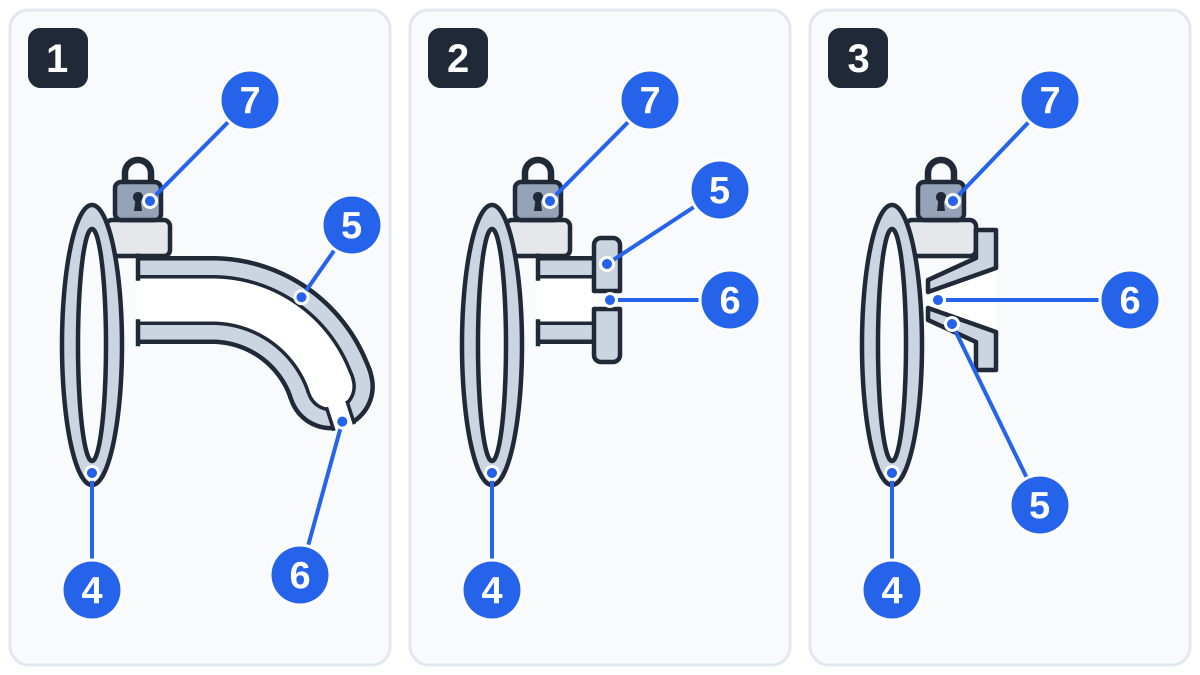
No study has compared injuries between designs, so none can be called safer than another. What can be compared is geometry: how much room a design leaves, where it presses and how much skin you can see and dry. All three usually attach to a base ring around the base of the penis and behind the scrotum, the part that matters most if swelling develops.
| Standard (curved) cage | Flat cage | Inverted cage | |
|---|---|---|---|
| Shape | A tube that extends forward from the base ring | A short cage closed by a flat front plate | A short tube that recedes toward the base ring instead of extending outward |
| Room for swelling or an erection | Some, depending on the tube length | Very little | Very little; the penis is held inward |
| Where to check for pressure | Ring edge, ring-to-cage gap, the rim where the tube starts, tip of the tube | Ring edge, the front plate and the edge of its opening | Ring edge, the receding tube and the edge of its opening |
| Seeing and drying the skin | Often partly visible through slots; proper drying needs removal | The plate hides most of the skin | The skin is held inside, close to the body |
| Urine | Leaves at the tip of the tube | Leaves through the plate opening, which has to line up with the urethral opening | Leaves close to the body, so drying afterwards takes more care |
| Safety studies | None for any design | ||
Less room means less margin: in flat and inverted designs, swelling or an erection presses straight against the plate or tube, and a problem under the plate is harder to spot early. That is a reason to check the skin more carefully, not evidence of more injuries. See our guides to flat chastity cages, inverted chastity cages and types of chastity cages.
Where to check for pressure, pinching and chafing
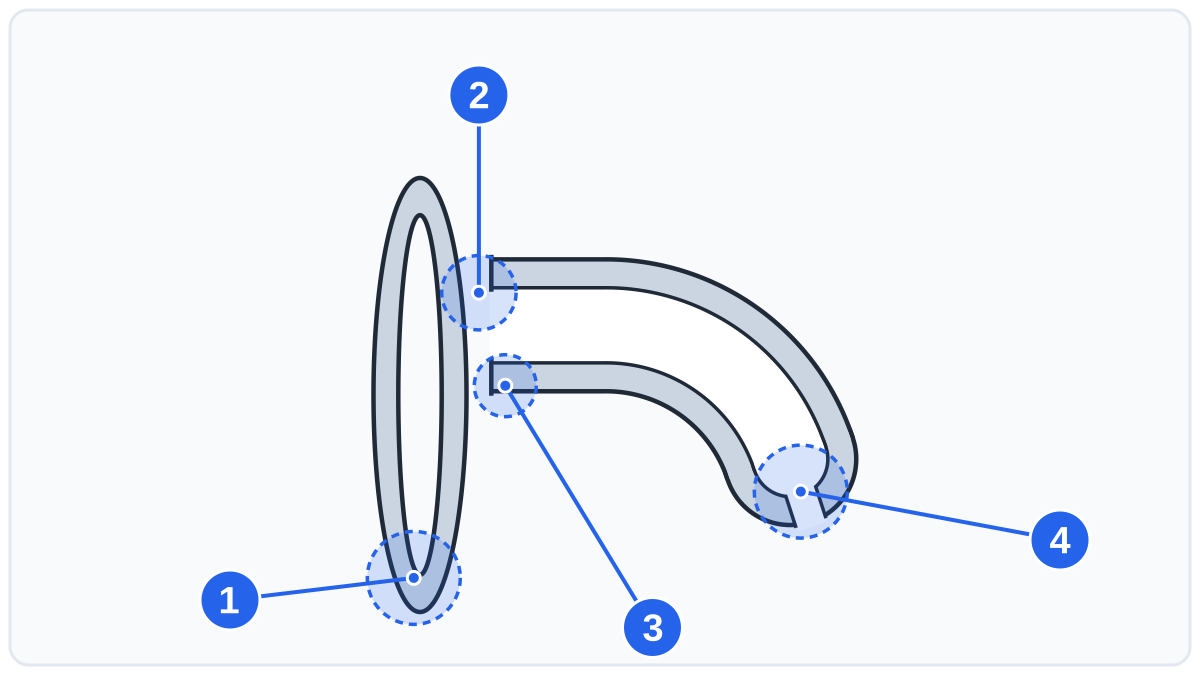
- Edge of the base ring. It presses on the base of the penis and the skin behind the scrotum. If the ring is too tight, this is where swelling gets trapped.
- Gap between the ring and the cage. Loose skin can be caught between the two parts and pinched when they are locked together.
- Edge of the cage opening, at the back of the tube. The rim where the tube starts, next to the ring gap, can press or rub on the skin as you move or sit.
- Tip of the tube. During an erection the head of the penis is pushed against the end of the cage, or against the plate of a flat cage.
Not every mark is an injury, but NHS guidance on pressure ulcers gives signs worth checking for under a ring or plate: "discoloured patches of skin that do not change colour when pressed", or a patch of skin that "feels warm, spongy or hard" (NHS: pressure ulcers). The guidance is written mainly for people who have difficulty moving, so applying it here is our inference. If you see these signs or broken skin, leave the device off until the skin heals, and get advice if it does not improve.
Chafing, pinching and trapped moisture
Friction and trapped moisture are a known cause of skin trouble in the groin. The Primary Care Dermatology Society (PCDS) explains that intertrigo, an inflamed rash where skin rubs on skin, is caused by friction "facilitated by moisture trapped in deep skinfolds where air circulation is limited", and that the damaged skin is "a fertile breeding ground for various pathogens", including bacteria and fungi such as Candida (PCDS: intertrigo). A device that rubs, and holds sweat or urine against the skin, can add to both. Dermatologists' advice for preventing chafing applies: "Stop your activity immediately if you experience pain or discomfort, or if your skin turns red" (American Academy of Dermatology). With a cage, that means taking it off.
Pinching happens where skin is caught between hard parts, often at the ring-to-cage gap. If a device pinches, take it off and recheck the fit rather than tightening it; see the sizing guide and how to put on a chastity cage.
Skin under a device can only be washed and dried properly with the device off. For an inflamed head of the penis (balanitis), the NHS advises washing "every day using just water or an emollient", drying gently and not using soap or shower gel, and it lists "not washing your penis properly" among the causes (NHS: balanitis). Clean the device itself as its maker instructs; our hygiene guide explains why device cleaning and skin care are separate jobs.
The material, and what you clean it with, can also irritate. Contact dermatitis is "most commonly caused by irritants such as soaps and detergents, solvents or regular contact with water", and allergic reactions can be triggered by "some metals, including nickel" (NHS: contact dermatitis). If metal jewellery irritates your skin, find out exactly what a metal device is made of before wearing it, and rinse cleaning products off thoroughly. Our materials guide lists questions to ask a maker.
Urinary and hygiene risks
In flat and inverted designs the opening sits close to the body, so urine can be left on the skin, and the PCDS lists urinary incontinence among the factors that predispose to intertrigo (PCDS). Dry carefully after urinating; our guide can you pee in a chastity cage? covers the practical side.
- Infection. Burning when urinating, needing to urinate more often or more urgently, cloudy urine or blood in it can be signs of a urinary tract infection. The NHS advises men with these symptoms to get an urgent GP appointment or call NHS 111 (NHS: UTIs); outside the UK, get urgent medical advice. No research shows whether cages change the risk.
- Blocked flow. A ring that traps swelling can block urine as well as blood: case reports describe "difficulty in urination" and urinary retention (Kato et al., 2026; Afrianto et al., 2025).
- Foreskin. If you have a foreskin, make sure it is in its usual position over the head of the penis before you fit a device. A foreskin that is pulled back and cannot return can leave the end of the penis "very swollen and painful"; this is paraphimosis, a medical emergency (NHS: paraphimosis).
How long can you wear a chastity cage?
There is no evidence-based answer for any design, flat, inverted or standard. With no clinical studies of chastity devices (Wang and Raad, 2026), no safe maximum has been established; times quoted online, from hours to months, are not based on research. This guide gives no wearing times, only what to watch and the limits that apply however long you wear one.
What to watch
- Fit. A base ring that is too tight can trap swelling; one that is too loose lets skin slip into the ring-to-cage gap.
- Design. Flat and inverted cages leave little room for swelling or erections and hide more of the skin, so problems are harder to spot early.
- Heat, sweat and activity. More moisture and friction make chafing more likely.
- The state of the skin. A device should not go over skin that is sore, broken or infected.
- Health conditions. The NHS lists poor circulation and "problems feeling sensation or pain" among the things that raise the chance of pressure ulcers (NHS), and diabetes among the conditions that can lead to balanitis (NHS). If these apply, or you have sickle cell disease or have had genital surgery or an injury, talk to a clinician before using a device.
Limits that apply however long you wear one
- The wearer can unlock the device at any moment, without needing a partner, an app, a timer or a phone.
- It comes off at the first warning sign and stays off until the skin is back to normal.
- It comes off so the skin underneath can be washed and dried.
- No tightening, smaller sizes or extra hardware to make removal harder.
- It does not stay on if you cannot feel the area normally.
Sleep and night-time erections
Erections during sleep are involuntary: they "occur naturally during REM sleep" (Hirshkowitz and Schmidt, 2005). A device "prevents full erections" (Wang and Raad, 2026) but cannot stop them starting, so at night the penis presses against the cage while you are not awake to notice pain or swelling. For that reason this guide does not recommend sleeping in a device. That does not mean daytime wear has been shown to be safe.
Long-term effects: what is known and what is not
What is documented
The lasting harm described in the medical literature follows constriction: a ring or other object that cut off blood flow, often one left in place for days before it was removed. One review notes that patients "often present after several days of ischemia and swelling have developed" (Silberstein et al., 2008). A 2024 review collected 100 published cases of penile strangulation from 2000 to 2019. Metal rings were the most common cause (36 cases), followed by plastic items such as bottles (13); others included metal tubes and threads such as hair. Twenty-four cases reported after-effects (sequelae), most often the need for skin grafts or for surgery to rebuild the urethra (Campbell et al., 2024). The review does not mention chastity cages, and its authors note that published reports "lack secondary management and long-term outcomes". In one recent report, a man had moderate erectile dysfunction after removal of a wrench that had been trapped on his penis for about three weeks (Afrianto et al., 2025).
What has not been studied
No study has followed people who wear a cage for months or years without an incident like this, so the effects of long-term wear on erections, sensation, penis size, the prostate and fertility are unknown. That applies to flat and inverted cages as much as to standard ones; what differs between designs is the day-to-day pressure and moisture described above.
- The 2026 expert-opinion article suggests that research on ejaculation frequency and prostate health, and on testicular temperature, offers "hypothetical biological frameworks through which prolonged device use could influence urologic outcomes" (Wang and Raad, 2026): reasons to study the question, not evidence of harm.
- Some scientists think sleep-related erections "protect the integrity of the penile cavernous bodies", the erectile tissue (van Driel, 2014). Whether restricting them with a cage matters has not been tested.
- Claims that cages cause permanent shrinkage or erectile dysfunction, or that years of wear are harmless, go beyond the evidence.
If erection problems keep happening, see a doctor or a sexual health clinic; the NHS notes they "might be a sign of a health condition that can be treated" (NHS: erection problems). Get checked, too, if numbness, pain or changes in urination continue after the device is off. For mood, arousal and relationship effects, see chastity cage effects; for long-term agreements between partners, see permanent chastity.
Plan emergency removal before you lock it
- Practise first. Open and close the lock with the device off your body until you can do it quickly.
- Keep the release with the wearer. A key that is frozen in ice, posted away, held by someone who is not there, or controlled by an app or a timer is not available in an emergency. Any agreement between partners should let the wearer take the device off at any time.
- Know what it is made of. Hard metals such as titanium can be difficult to cut: in one case, conventional ring cutters failed on a titanium ring and a 24-inch bolt cutter was used instead (Weston and Golden, 2026), and removal "may require industrial equipment that is not within the confines of normal operating room tools" (Patel et al., 2018). Tell the staff the material and show them how the lock works.
- Do not cut it off yourself. Cutting metal close to swollen skin risks cuts and burns. In one hospital removal, heat from sawing a ring caused a burn "despite use of irrigation during sawing to keep the ring cool" (Patel et al., 2018), and in another case a man's own attempts to remove a ring left several superficial cuts on the head of the penis (Kato et al., 2026).
- If it is stuck, go now. Stop pulling against swollen tissue and go to an emergency department (A&E in the UK). Clinicians choose a removal technique according to the device, how long it has been stuck and the tools available (Silberstein et al., 2008).
Our guide to putting on a chastity cage covers fitting and quick removal step by step.
Frequently asked questions
Are flat chastity cages safe?
No study has tested flat cages, or any other design. With little room behind the plate, swelling or an erection presses straight against it, and the skin is hard to check and dry.
Are inverted chastity cages safe?
There is no research on them either. Holding the penis inward can press on its head and keeps moisture close to the body, and checking the skin means taking the device off.
Do chastity cages have permanent effects?
Permanent injuries are documented when a ring or object traps swelling and removal is delayed. Whether long-term wear without such an incident has lasting effects has not been studied.
Can a chastity cage cause erectile dysfunction?
Erection problems have been reported after a constriction injury in at least one case report, but long-term wear without an injury has not been studied. If erection problems keep happening, see a doctor or a sexual health clinic.
Can you sleep in a chastity cage?
Sleep erections are involuntary, so a cage will meet them while you cannot react to warning signs. This guide does not recommend sleeping in a device.
What if a chastity cage will not come off?
Stop pulling. If there is swelling, pain, numbness or a colour change, go to an emergency department (A&E in the UK) now. Even without symptoms, get medical help promptly rather than waiting, because swelling can make removal harder. Do not cut it off yourself.
Sources
Sources checked in October 2026. ChastityTek is developing its own device, Veru One; it is not yet available to buy, and this guide makes no claims about it.
- Wang JL, Raad RJ. Male chastity devices: considerations for prostate and testicular health. The Journal of Sexual Medicine, 2026; 23(6): qdag163. Expert opinion.
- Campbell KJ, Kwenda EP, Bozorgmehri S, Terry RS, Yeung LL. Penile strangulation: analysis of postextrication follow-up, sequelae, and a review of literature. American Journal of Men's Health, 2024; 18(1): 15579883231223366.
- Silberstein J, Grabowski J, Lakin C, Goldstein I. Penile constriction devices: case report, review of the literature, and recommendations for extrication. The Journal of Sexual Medicine, 2008; 5(7): 1747–57.
- Patel NH, Schulman A, Bloom J, et al. Penile and scrotal strangulation due to metal rings: case reports and a review of the literature. Case Reports in Surgery, 2018: 5216826.
- Weston GF, Golden BM. Successful emergency removal of a titanium penile constriction ring using blood aspiration and nonpowered bolt cutters. Cureus, 2026; 18(2): e104026.
- Kato A, Mitsui Y, Yamabe F, et al. Successful release of penile strangulation caused by rigid constriction device using a modified string method: a case report. Clinical Case Reports, 2026; 14(7): e73169.
- Afrianto A, Renaldo J, Soebadi MA. Management of prolonged wrench penile entrapment: a case report and literature review. International Journal of Surgery Case Reports, 2025; 137: 111985.
- Hirshkowitz M, Schmidt MH. Sleep-related erections: clinical perspectives and neural mechanisms. Sleep Medicine Reviews, 2005; 9(4): 311–29.
- van Driel MF. Sleep-related erections throughout the ages. The Journal of Sexual Medicine, 2014; 11(7): 1867–75.
- Primary Care Dermatology Society. Intertrigo.
- American Academy of Dermatology. How to prevent and treat blisters.
- NHS: testicle pain, priapism, phimosis and paraphimosis, balanitis, urinary tract infections, enlarged prostate (urinary symptoms), cellulitis, contact dermatitis, pressure ulcers and erection problems.