
Practising sissy chastity every day means keeping the role and your agreement with a keyholder going each day; it does not mean wearing a chastity device around the clock. The daily part can be a check-in, clothing chosen for the role or an agreed task. A device, if you use one, is worn for limited periods while you are awake, comes off for washing and sleep, and comes off at once if anything hurts.
This guide sets out a practical routine for consenting adults. For the basics, read what sissy chastity is; for rules, keyholding and safety in depth, see our complete guide to sissy chastity. If anything hurts now, go to the warning signs.
- Daily practice is about the role and the agreement; days without the device still count.
- No wearing time has been shown to be safe, so this guide sets no hours or targets.
- The wearer can always take the device off at once. Pain, numbness, swelling or a change in colour means it comes off now.
What daily sissy chastity means
In sissy chastity, a consenting adult takes on a feminine, submissive "sissy" role and wears a male chastity device, usually by agreement with a partner, the keyholder, who holds the key. "Every day" describes how often the role is part of your life, not how long a device stays on.
That difference matters because nobody knows how long a device can be worn safely. A 2026 expert-opinion article in The Journal of Sexual Medicine notes that male chastity devices "have not been evaluated in clinical or epidemiologic studies" (Wang and Raad, 2026). On device-off days the role carries on through the parts that need no hardware, such as a check-in, a journal entry, clothing at home or a name used in private. And because the device also comes off for washing and for sleep, a daily routine never means continuous wear.
Agree the rules before the routine
Make the agreement calmly, sober and outside play, and write it down. For a daily routine, cover at least these points:
- A stop signal, such as a safeword or a traffic-light system (green, yellow, red), that also works by message.
- Immediate removal. The key or release stays within the wearer's reach. A key that is frozen in ice, posted away, held by someone who is not there, or locked behind a timer or an app is not immediate.
- Health first. Pain, skin problems, a medical appointment or a change of mind end a session without penalty, and removal is never something the wearer has to earn.
- Device-off days, decided together and always available.
- The scope of the role: which clothing, names, forms of address and tasks are in, and where. Anything not agreed is out.
- Privacy and review: photos, messages and who else, if anyone, knows, plus a regular time, such as once a week, to change the rules.
A short daily check-in keeps you both informed: the wearer reports on comfort, skin, sleep and mood, and the keyholder listens and adjusts. Mention rubbing or pinching the same day. If you practise alone, a brief journal entry does the same job. Our 30-day planning guide builds a first month around conversation rather than wearing time, and our guide to chastity in femdom relationships covers keyholding and aftercare.
A sample daily routine
Adapt this outline to your own agreement. It deliberately contains no wearing times.
| Step | What to do |
|---|---|
| Daily check-in | Agree the day's role, and whether the device is worn at all. |
| Before fitting | Wash and dry, look over the skin, check the device for cracks or rough edges, and put the key where you can reach it. Fit the device as described in how to put on a chastity cage. |
| While wearing | Stay awake and within reach of the key. Pat dry after using the toilet, and take the device off at the first warning sign. |
| After removal | Wash, dry and check the skin, then clean the device as its maker instructs and let it dry. |
| Before sleep | The device is off. |
| Device-off days | Keep the role going through the check-in, clothing, a task or a journal entry. |
| Weekly review | Talk over anything that rubbed, worried either of you or no longer appeals, and change the rules if needed. |
Choosing a device
Choose a device that fits, is easy to clean and inspect, and comes off quickly. Colour is only a matter of looks. Length is a matter of fit: a shorter cage leaves less room, not more comfort.
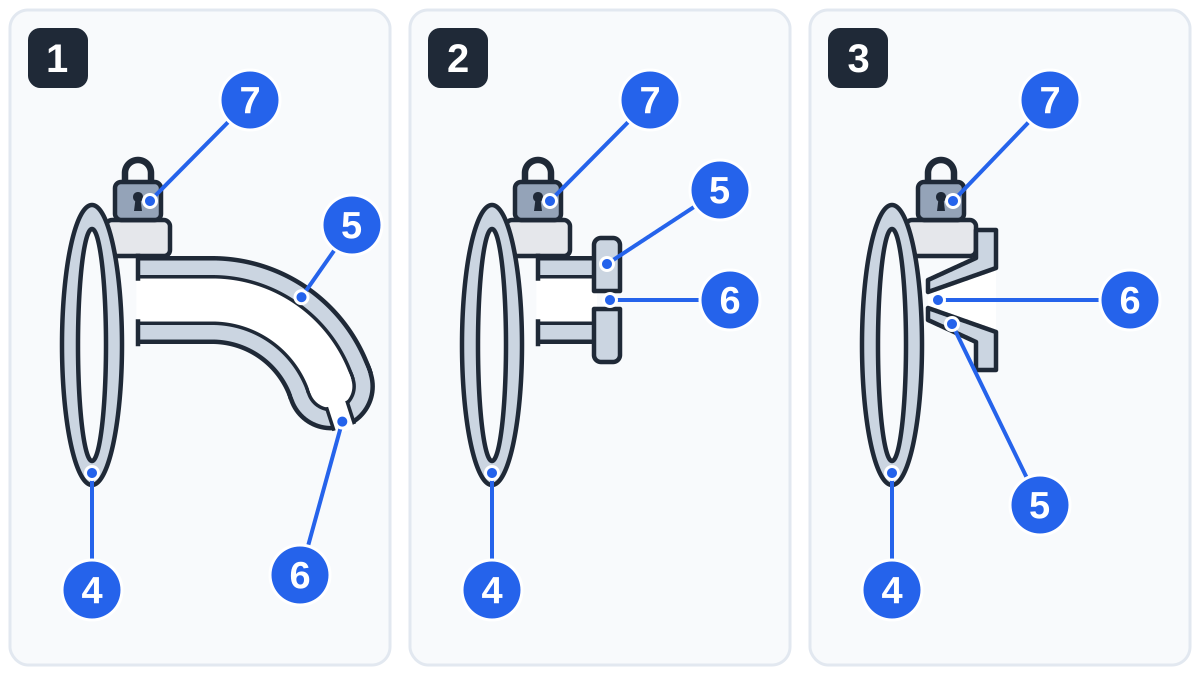
- Design. Flat and inverted cages leave much less room inside than a standard tube, so any swelling meets the device sooner. Compare the designs in our guide to the types of chastity cages.
- Fit, not looks. A smaller cage is not a goal. Compare internal dimensions with our sizing guide, and never force a device on: if it only closes under pressure, it does not fit, and lotion or lubricant will not change that.
- Material. Allergic skin reactions can be triggered by "some metals, including nickel" (NHS: contact dermatitis), so ask exactly what a metal device is made of. Our materials comparison lists what to ask a maker.
- Quick release. Practise opening the lock with the device off your body.
Hygiene: wash and dry with the device off
Rinsing through the bars of a cage does not clean or dry the skin underneath. Take the device off to wash, dry and check the skin, and clean the device separately; our hygiene guide explains why these are separate jobs.
- Washing. Devon Sexual Health, an NHS service, advises using "just warm water or gentle soap", cleaning underneath the foreskin, not scrubbing and patting dry (Devon Sexual Health: genital hygiene). The NHS lists "not washing your penis properly" among the causes of balanitis, a sore, swollen head of the penis, and notes that soap and shower gels can irritate the skin (NHS: balanitis).
- Sore skin. If you have balanitis, NHS advice is to wash every day using just water or an emollient (a moisturising treatment), dry gently, avoid soap and shower gel, and wash your hands before peeing or touching your penis (NHS: balanitis). Leave the device off while the skin is sore.
- Foreskin. If you have one, return it to its usual position over the head of the penis after washing. A foreskin that is pulled back and cannot return is a medical emergency called paraphimosis (NHS: tight foreskin).
- Drying. Thrush, a common yeast infection, "tends to grow in warm, moist conditions", and NHS advice for easing it and stopping it coming back includes drying properly after washing, wearing cotton underwear and not wearing tight underwear (NHS: thrush). Let the skin and the device dry fully before you refit it.
- The device. Clean it as its maker instructs and rinse cleaning products off well: contact dermatitis is "most commonly caused by irritants such as soaps and detergents" (NHS: contact dermatitis).
For peeing and drying while the device is on, see our guide to using the toilet in a chastity cage.
Daily skin checks and warning signs
Each time the device comes off, check the skin in good light, especially where the device presses or rubs.
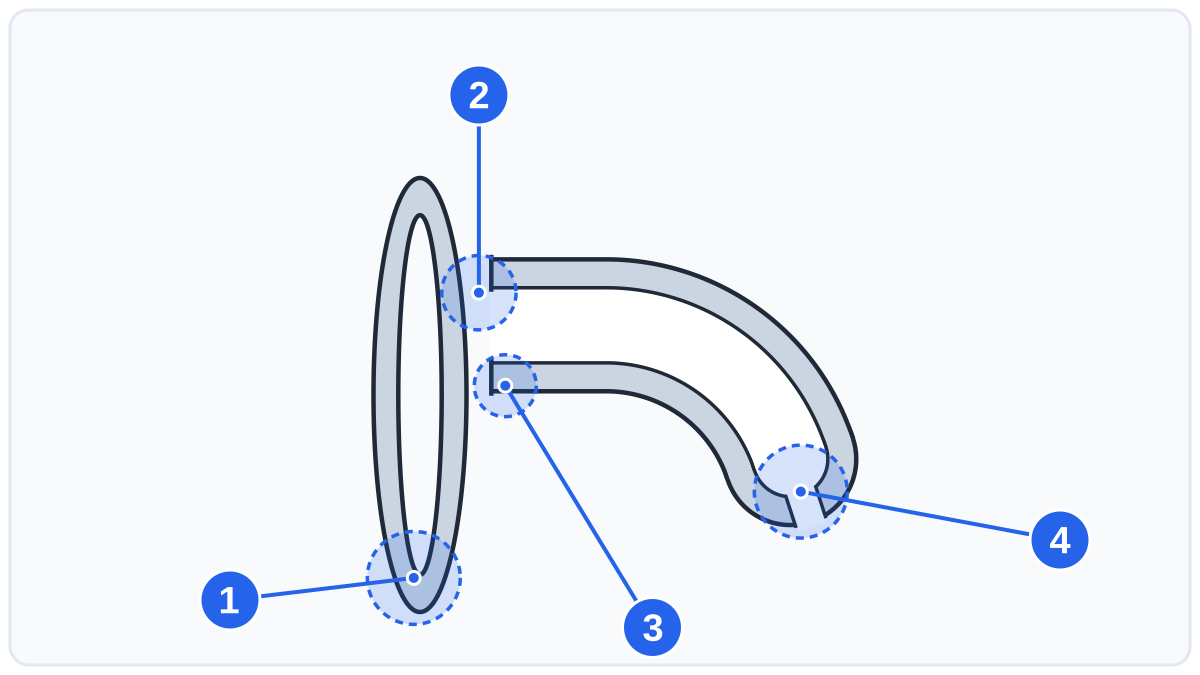
Look for redness, chafing, broken skin, a rash, swelling, soreness at the head of the penis and any change in colour or feeling. In its advice on preventing friction blisters, the American Academy of Dermatology says: "Stop your activity immediately if you experience pain or discomfort, or if your skin turns red" (AAD). Leave the device off until the skin is back to normal. If a problem keeps coming back, the fit, design or material may not suit you; our guide to chastity cage risks and long-term effects goes into more detail.
Take the device off straight away for
- pain, pinching or pressure that builds;
- numbness or reduced feeling;
- swelling, or a dusky or unusual colour;
- difficulty peeing.
A cage's base ring is often "positioned behind the scrotum" (Wang and Raad, 2026), circling the base of the penis and scrotum. Case reports of metal rings trapped at the base of the penis describe these signs: "decreased sensation" and "severe swelling" (Patel et al., 2018), "pain, swelling, and discoloration" (Weston and Golden, 2026) and "difficulty in urination" (Kato et al., 2026). None of these cases involved a chastity cage.
See a doctor or sexual health clinic
Leave the device off and see a doctor (a GP in the UK) or a sexual health clinic if the head of the penis is swollen, itchy, sore or red, it hurts to pee, or there is a discharge. These can be symptoms of balanitis (NHS: balanitis).
Get emergency help
Call your local emergency number (911 in the US, 999 in the UK) or go to an emergency department (A&E in the UK) if:
- the device will not come off, or swelling stops you removing it;
- pain, numbness, swelling or a change in colour does not settle soon after the device is off;
- you have sudden, severe pain in a testicle, testicle pain with nausea, vomiting or abdominal pain, or testicle pain that has lasted more than an hour or continues when you are resting (NHS: testicle pain);
- an erection lasts more than 3 to 4 hours, or a painful erection lasts more than 1 hour if you have sickle cell disease (NHS: priapism);
- a foreskin that has been pulled back cannot return over the end of the penis (NHS: tight foreskin).
Do not wait for swelling to go down on its own. A review of penile constriction devices describes a device trapped on the penis as "a urologic emergency": people who reach treatment later tend to have more serious injuries, while "with rapid intervention and removal of the foreign body, most patients do extremely well" (Silberstein et al., 2008). Never try to cut a metal device off yourself. In one hospital case, sawing through a ring caused a burn "despite use of irrigation during sawing to keep the ring cool" (Patel et al., 2018). Tell the staff what the device is made of and how it opens.
Sleep and night-time erections
Take the device off before you go to sleep. Erections during sleep are involuntary: they "occur naturally during REM sleep" (Hirshkowitz and Schmidt, 2005), and the International Society for Sexual Medicine notes that men "typically have 3 – 5 erections per 8 hours of sleep" (ISSM). A chastity device "prevents full erections" (Wang and Raad, 2026) but cannot stop them from starting, so each one presses against the device while you are asleep and less able to notice pain, numbness or swelling.
For that reason this guide does not recommend sleeping in a device, and this routine has no overnight stage to work up to. Fit the device after you are up and awake, and if an erection in the device becomes painful at any time, take it off.
Discretion under clothes
Supportive underwear that holds the device still without squeezing, and structured, darker trousers with a little room, show the least; thin, clingy fabrics show the most. Never make a device less visible by pressing it tighter against your body or by choosing a smaller size. For exercise, the American Academy of Dermatology recommends "moisture-wicking, loose-fitting clothes" (AAD), and because a chastity device is not protective sports equipment, take it off for contact sports. Our guide to hiding a chastity cage under clothes covers designs, underwear, the gym and airport security.
Discretion is about privacy, not about involving other people. Keep the role away from colleagues, friends and strangers who have not agreed to be part of it.
Identity and feminine expression
For some people the role is what makes the practice daily: clothing chosen for the role, skincare or nail care, a feminine name used in private, or changes in voice and mannerisms. All of it is optional. Explore at your own pace and within what you have both agreed.
Outside kink, "sissy" is often used as an insult for men seen as effeminate. Some adults choose it as a label for their own role and others prefer terms such as feminization play, so use only the words the wearer is comfortable with. If you include teasing or humiliation themes at all, agree off-limits words and topics in advance, and talk afterwards about how they felt.
Enjoying a feminine role does not by itself say anything about your sexual orientation or gender identity, but it can raise real questions. The NHS describes gender dysphoria as feeling "distressed or uncomfortable for a long time because the gender you feel you are (your gender identity) is different to your sex registered at birth", and advises seeing a GP if you think that might apply to you (NHS: gender dysphoria and incongruence). In the US, start with a primary care doctor.
The interest itself is not a sign that something is wrong. A large national survey in Australia found that people who had engaged in BDSM were "not significantly more likely to be unhappy or anxious" (Richters et al., 2008). If it causes you distress, a counsellor or sex therapist who is comfortable with kink can help. Online forums can make people feel less alone; treat advice from strangers with care and protect your identity and photos.
When to pause or stop
Pause, change the arrangement or stop if:
- a warning sign appears, or the same skin problem keeps coming back;
- the device stays on because of a rule, a dare or pride rather than comfort;
- either of you feels unable to say no, or keeps going out of guilt;
- the role starts to affect work, sleep or people who have not agreed to it;
- the wearer feels persistently low, anxious or ashamed after play;
- it has stopped being enjoyable for either of you.
Stopping, or switching to device-free days for a while, is not a failure. A good daily arrangement is one that both people can change or end.
Frequently asked questions
Can you wear a chastity cage every day?
Nobody can say whether daily wear is safe: chastity devices have not been clinically studied, and there is no evidence-based number of hours to aim for. Daily sissy chastity does not require daily wear. When you do wear a device, keep to limited periods while you are awake, and take it off for washing, skin checks and sleep.
Can I shower in a chastity cage?
Water running through a cage does not clean or dry the skin underneath. Take the device off to wash and dry the skin, and check the maker's instructions before getting the device wet.
Can I sleep in a chastity cage?
This guide does not recommend it. Erections during sleep are involuntary and happen several times a night, and the device presses against each one while you are asleep and less able to notice warning signs.
What daily rules or tasks can a keyholder set?
Examples include a check-in, clothing worn at home, a household task, a journal entry or a form of address used in private. Every rule is optional and open to review, and none can delay removal for pain, hygiene, a health concern or a change of mind.
What if I don't have a keyholder?
You can practise alone, with the key within immediate reach and a journal for your check-ins. Be wary of strangers online who offer to hold a key and then ask for money, personal details or photos.
Does a pink chastity cage make a difference?
Only to the look. Choose by fit, internal dimensions and finish rather than colour, using our sizing guide.
This article is general information for adults, not medical advice. ChastityTek is developing its own device, Veru One; it is not yet available to buy.