
A cock ring is a ring you wear snugly around the base of the penis, or around the penis and scrotum together. It slows the blood leaving the penis, so an erection stays firmer for longer. Medical sites call it a constriction ring. Everybody else calls it a cock ring.
The type you pick decides two things: how the ring fits, and how fast you can get it off again. Keep that second one in mind. It comes up a lot.
This page is the map. The detail lives on three others: what a cock ring does (and what it doesn't), how to use a cock ring from putting it on to taking it off, and cock ring sizes.
Types of cock rings
The Sexual Medicine Society of North America (SMSNA) splits rings into two camps. Fixed rings have a set diameter. Adjustable ones use closures, snaps or a drawstring, so you set the tightness yourself. After that, it's down to material and extras, such as a vibrating pod or the textured pad on a grind ring.
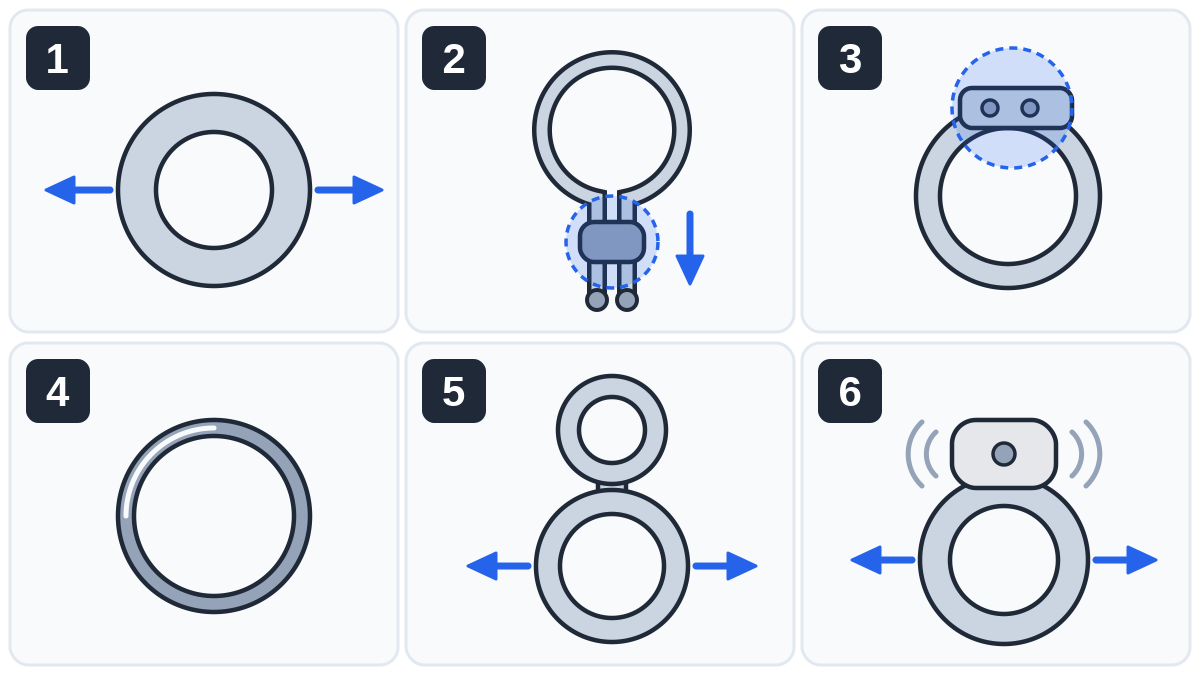
| Type | Made of | Stretch | How it comes off | Sizing | Watch out for |
|---|---|---|---|---|---|
| Solid stretchy ring | Silicone, TPE or rubber | Yes | Stretch it and ease it off | Inner diameter, plus stretch | Too tight a fit |
| Adjustable, with a bead or knuckle clamp | A flexible cord or strap through a sliding bead or clamp | Adjusts | Slide the bead or open the clamp | One size that adjusts | Over-tightening, or a release you can't grip |
| Snap or strap band | Silicone or leather | Adjusts | Pop the snaps or undo the strap | Set by the snap positions | Leather, which is hard to keep clean |
| Rigid metal ring | Steel or titanium | None | Back the way it went on, unless it's magnetic or multi-piece | Fixed inner diameter, so see cock ring sizes | Getting stuck: metal rings are the most reported cause (Silberstein et al., 2008) |
| Cock and ball ring | Any of the above | Depends on the build | Reverse the fitting order, or undo it | One bigger loop or two, around penis and scrotum | Rigid ones turn up in case reports of trapped rings (Patel et al., 2018) |
| Vibrating ring | A ring with a vibrating part attached | Same as the ring it's built on | The electronics: never boil it | ||
| App-connected ring | A ring with pressure sensors that record erectile fitness data and display it in a phone app | Same as the ring it's built on | What the app records and who sees it (how to vet one) | ||
I've been through just about every cock ring on the market, vibrating ones included, and the ones that work best for me are adjustable rings with a knuckle or bead clamp. Closed, non-adjustable rings are rarely worth it in my experience, because they so seldom fit perfectly. I also keep lube and oil off the strap itself so the clamp holds, which is about grip, not skipping lube (more in fitting an adjustable ring).
Cock and ball rings
A cock and ball ring goes around the scrotum as well as the base of the penis. It's either one bigger ring around both or two connected loops, which SMSNA calls penoscrotal or double rings. Testicle-only rings and ball stretchers are a different thing: they go around the scrotum alone.
What goes through first? With a one-piece ring, the usual order is the testicles one at a time, then the soft penis, and the reverse to take it off. Guides online don't all agree, so if your ring came with instructions, follow those. The steps are in how to put on a cock ring. If you've ever fitted a chastity cage base ring, you already know the routine: it sits in the same place. So does our own Veru One.
Rigid versions are where it gets serious. Case reports describe metal rings around both the penis and the scrotum that wouldn't come off (Patel et al., 2018), including one that had been on for more than 48 hours (Harris et al., 2020). If you want a cock and ball ring, pick a stretchy or adjustable one you can get off quickly, and keep to the same time limits. For measuring the bigger loop, see cock ring sizes.
Silicone, rubber, leather or metal?
Silicone is the sensible default. SMSNA calls silicone rings flexible and generally the most comfortable to wear, and FDA guidance for medical rings asks for "soft and pliable materials" to limit injury to you or a partner. TPE and rubber stretch too, but SMSNA flags porous rubber and leather as materials that can pass on bacteria.
Cheap "jelly" toys deserve a side-eye. When Denmark's environment agency surveyed sex toys in 2006 (toys in general, not rings), "jelly" turned out to be soft PVC that could be up to 70% plasticiser, and most products didn't say what they were made of. Old data, but a good reason to buy a ring that names its material.
Leather has its fans for the texture and feel, but it isn't easy to clean, which is why SMSNA calls it not the safest option for sex.
Metal is the one the experts warn about. The International Society for Sexual Medicine (ISSM) puts it bluntly: "Metal rings should be avoided." A rigid ring can't stretch if things swell. Getting a stuck one off can take bolt cutters and the fire department, and titanium or heavy-density alloy rings can resist standard hospital cutting tools (Patel et al., 2018; Weston and Golden, 2026). Some makers now sell metal rings with magnetic releases, which SMSNA counts as a safety step. The ring itself still won't stretch, though.
How cock rings work and fit, in short
A ring doesn't pump anything in. It just slows the exit: FDA guidance describes rings placed around the base of the erect penis "to restrict venous blood flow leaving the penis". For what that does and doesn't get you, see what a cock ring does.
A shaft-only ring sits at the base of the penis, and a cock and ball ring goes around the scrotum too. FDA guidance has rings sold as medical devices labelled for 30 minutes per use at most, which is a labelling rule, not a proven safe time. How to use a cock ring takes you from putting one on to getting it off again.
Fit comes down to the inside diameter and how much the ring gives. FDA guidance says to use "the least constrictive ring size that maintains an erection". Measuring, and the circumference-to-diameter maths, are on cock ring sizes.
How to choose a cock ring
Forget the adjectives on the box. Check these instead.
- A release you can grab. FDA guidance for medical rings asks for "a simple and quick method to manually release" the ring, with a tab, handle or loop wide enough to grip. Snaps, clamps and pull tabs do that job. A solid metal ring has nothing to grab.
- Adjustable or fixed. An adjustable ring forgives a bad guess on size, while a fixed one has to be right from day one. My vote goes to adjustable rings with a bead or knuckle clamp.
- Soft and smooth. The same guidance asks for soft, pliable materials and a smooth shape with as few protrusions and pressure points as possible. Heavy, dense metal is the opposite.
- A label that tells you something. If a listing won't say what the ring is made of or how to clean it, move on.
- Vibrating rings: where the motor sits. Vibrating rings double as couples toys (SMSNA), so the question is whether the vibration actually reaches your partner. In my experience, on a closed ring it often doesn't. Check the water rating too, since it decides how you can clean it.
- App rings: the data. Connected toys usually pair with your phone over Bluetooth, and some route features through the maker's cloud. Two non-ring cases show what can go wrong. We-Vibe's maker settled in 2017 for US$3.75 million over claims its app collected data on how its vibrators were used, without admitting wrongdoing. And in 2025, flaws at Lovense could expose users' email addresses and allow account takeovers, which the company said it had fixed or was fixing. So run through our privacy checklist before you pair one.
Cleaning, lube and storage by material
Start with the cleaning instructions that came with your ring, as Planned Parenthood suggests. For the basics, one university sexual health store's care guide says to wash a ring with mild, unscented soap and warm water before and after every use, let it air-dry, and store it cool and dry, not touching your other toys.
| Material | Cleaning | Lube |
|---|---|---|
| Silicone | Soap and warm water. The same guide says 100% silicone rings that don't vibrate can also go in boiling water for 3 minutes, but only if your maker allows it. | Water-based. The guide warns that silicone-based lube can damage the toy. |
| TPE, TPR or rubber | Soap and warm water, then follow the maker. The boiling tip is for 100% silicone only. | Water-based |
| PVC "jelly" | Soap and warm water, then follow the maker. | Water-based, never oil. In the 2006 Danish test, oil-based lube pulled about 100 times as much of the phthalate DEHP out of a soft-PVC toy as water-based lube did. |
| Metal | Soap and warm water, then follow the maker. | Water-based |
| Leather | Hard to clean properly, so follow the maker's care instructions to the letter. | Follow the maker. |
| Anything vibrating | Only as far as its water rating allows, and never boil it, because of the electronics. | As for its material. |
Safety at a glance
We couldn't find a single study that pins down a safe wearing time for a cock ring. What does exist is labelling guidance for medical rings, ISSM's advice and case reports of stuck rings, and together they boil down to five rules.
- 30 minutes, then an hour off. FDA guidance asks makers of rings sold as medical devices to label them "no longer than 30 minutes per use" and to leave at least 60 minutes between uses. That's a labelling limit, not a tested safe time, and we'd treat it as the ceiling for any ring. More on how long you can wear one.
- Never sleep in one, and skip it after drinking or drugs. Both are on the FDA's list of warnings for rings.
- Off at pain, numbness or cold. ISSM says to take a ring off right away if it hurts, goes numb or the penis starts to feel cold.
- Stuck means emergency care, now. A ring that won't come off is a urologic emergency, swollen or not, so go to an emergency department (A&E in the UK). If things are swelling, ISSM's advice is to seek emergency treatment immediately. Delay is linked to worse injuries, while with quick removal most people do extremely well (Silberstein et al., 2008). Don't try to cut it off yourself. Our chastity guide on constriction injuries explains why.
- Metal is the big one, but soft rings aren't exempt. Metal rings are the most commonly reported cause of the penis getting trapped (Silberstein et al., 2008), and ISSM says to avoid them. Every rule above applies to soft rings too.
One more, and this one is our inference, not a guideline: if you have reduced sensation in the penis, from nerve damage for example, you might not notice the warning signs these rules rely on, so check with a doctor first. The how-to guide lists the warning signs in full, and what to do if a ring gets stuck.
Cock ring FAQ
What are cock rings made of?
Mostly silicone, TPE or rubber, leather, or metal such as steel and titanium. Silicone is generally the most comfortable.
Which type should a beginner start with?
Something soft or adjustable, with a release you can grab. Soft materials and a quick release are what FDA guidance asks of medical rings anyway. Adjustable is the easier start, because you can correct the fit as you go, and a stretchy silicone ring is the simple option once you know your size. Leave metal on the shelf.
Are cock rings safe?
Lots of people use them. The serious harms doctors warn about are rings left on too long and rings that get stuck. We couldn't find a study that tested a safe wearing time, so stick to the rules in safety at a glance.
Can you share a cock ring?
The NHS advice on sex toys is not to share them, or to wash them and cover them with a new condom before anyone else uses them, because infections such as chlamydia can spread through fluids left on toys. If you do share a ring, wash it properly between people, and keep hard-to-clean leather to one owner.
Is soft or metal better?
Soft, for nearly everyone. Metal rings are the most reported cause of trapped rings (Silberstein et al., 2008) and the type ISSM says to avoid. Soft rings still follow the same time and warning-sign rules.
Do cock rings work?
Keeping an erection firm is what they're designed for, and FDA guidance describes rings used on their own when an erection can be achieved but not kept. Claims beyond that get shakier, and what a cock ring does sorts the evidence from the marketing.
Can you make your own?
Please don't. A homemade ring has no quick release, and everyday metal rings turn up in the medical literature. A review of 100 published cases of objects stuck around the penis lists ball-bearing rings, steel and iron rings, wedding rings and metal hoops among them (Campbell et al., 2024). In one 2026 case, a titanium wedding ring stuck at the base of the penis needed a 24-inch bolt cutter (Weston and Golden, 2026).
How common are cock rings?
Common enough that you're in good company. In an online survey of more than 25,000 gay and bisexual men in the US, recruited through one website, 51.9% had used a non-vibrating cock ring (Rosenberger et al., 2012). In a separate panel of nearly 12,000 people in six European countries, penis rings were among the next most commonly owned toys after dildos and vibrators (Hald et al., 2025). Neither sample represents everyone. And if a ring isn't what you're after, other sex toys for men work in completely different ways.
Sources
Sources checked in November 2026. The app-privacy news stories are linked where they come up.
- US Food and Drug Administration. External penile rigidity devices: Class II special controls guidance document for industry and FDA staff. 2004.
- International Society for Sexual Medicine. What is a constriction ring? Why should one be used with caution? 2014.
- Horwitz R. Different types of penile constriction rings. Sexual Medicine Society of North America.
- Silberstein J, Grabowski J, Lakin C, Goldstein I. Penile constriction devices: case report, review of the literature, and recommendations for extrication. The Journal of Sexual Medicine, 2008; 5(7): 1747-57.
- Patel NH, Schulman A, Bloom J, et al. Penile and scrotal strangulation due to metal rings: case reports and a review of the literature. Case Reports in Surgery, 2018: 5216826.
- Harris E, Llompart D, Izquierdo G, Aziz MA. Patient with penile and scrotal strangulation due to prolonged use of a metal ring device. Cureus, 2020; 12(12): e11928.
- Weston GF, Golden BM. Successful emergency removal of a titanium penile constriction ring using blood aspiration and nonpowered bolt cutters. Cureus, 2026; 18(2): e104026.
- Campbell KJ, Kwenda EP, Bozorgmehri S, Terry RS, Yeung LL. Penile strangulation: analysis of postextrication follow-up, sequelae, and a review of literature. American Journal of Men's Health, 2024; 18(1): 15579883231223366.
- Danish Environmental Protection Agency. Survey and health assessment of chemical substances in sex toys. Survey of chemical substances in consumer products no. 77, 2006.
- University of Guelph Student Wellness. Sexual Health Store cleaning and usage guide (PDF).
- Planned Parenthood. Masturbation.
- NHS: gonorrhoea and chlamydia.
- Rosenberger JG, Schick V, Herbenick D, Novak DS, Reece M. Sex toy use by gay and bisexual men in the United States. Archives of Sexual Behavior, 2012; 41(2): 449-58.
- Hald GM, Pavan S, Øverup CS. Do sex toys make me satisfied? The use of sex toys in Denmark, Norway, Sweden, Finland, France, and the UK. The Journal of Sex Research, 2025; 62(5): 735-49.