
A long-distance sex toy is an app-connected toy your partner can control over the internet, from the next town or the other side of the world. The research term for all this is teledildonics (yes, really), and a 2026 study defines it as "internet-connected sex toys enabling remote and interactive sexual experiences".
The toys are the easy part. The bit most guides skip is privacy: these apps handle about the most personal data you have, and several makers have leaked it. Sharing a sofa rather than a time zone? Then remote control toys used in the same room may suit you better. For the bigger picture, start with sex toys for men.
How long-distance sex toys connect
Most app toys work as a chain. As ESET describes it, the toy is usually controlled over Bluetooth Low Energy from an app on your phone, and the app logs you in through a cloud server "which stores the person's account information". In some cases, that service "also acts as an intermediary between partners", passing on chat and handing over control of the toy.
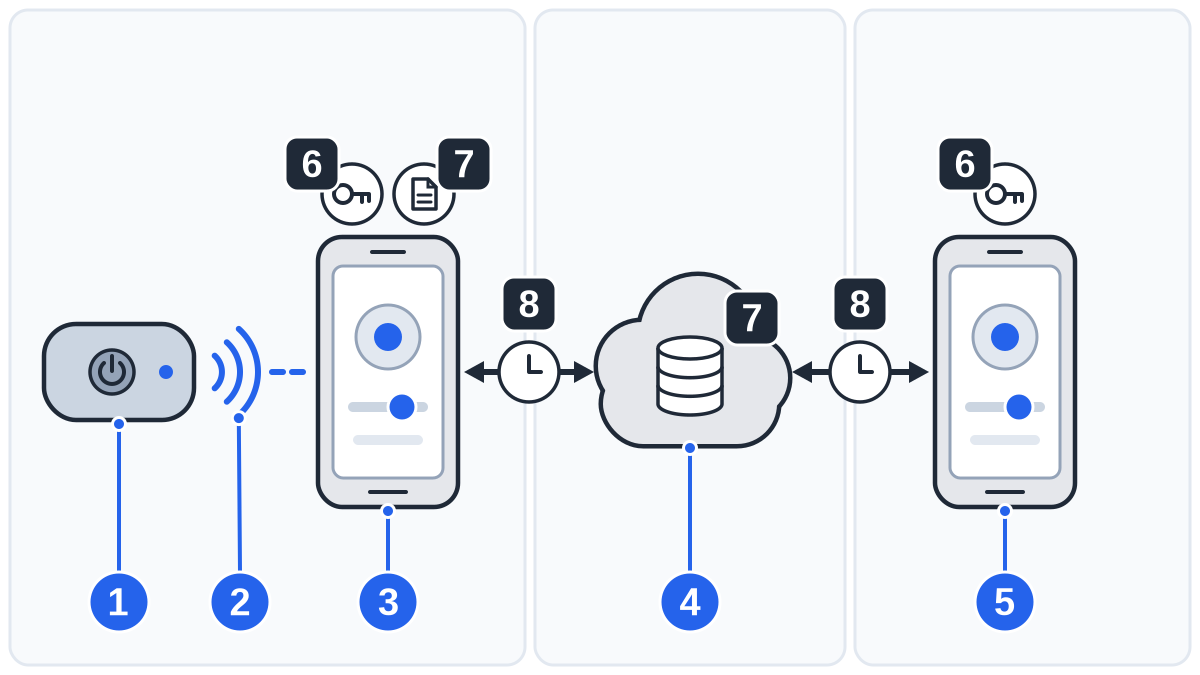
That relay is how makers get to promise the world. KIIROO's Fleshlight Launch manual says paired devices work "from anywhere in the world", and Lovense says its toys work "no matter the distance" if you both have Wi-Fi or mobile data. Both are maker claims.
It's also why you'll usually both need the app and an account. The server has to know who may control whose toy.
Lag comes from the same chain. Every command travels from your partner's phone to the server, then to your phone, then over Bluetooth to the toy. A weak link anywhere slows everything down.
The short hop can drop out too. To hold the connection, We-Vibe's FAQ says to keep the toy within Bluetooth range and the app active, not pushed into the background. In the same room you can often skip the server altogether, which is where same-room remote control comes in.
Types for men and couples
Same setup every time. What changes is the thing being controlled.
| Type | How it connects | Account for long-distance play? | Works without the app? | Water rating |
|---|---|---|---|---|
| App strokers (automatic sleeves) | Bluetooth LE to your phone, the maker's server for distance | Lovense: yes, for both partners | KIIROO's manual describes a manual mode on the toy | Check the manual |
| App vibrating rings | The same, on a ring at the base of the penis | Lovense: yes. We-Vibe: not stated | We-Vibe describes a button on its ring | Check the manual |
| App prostate massagers | The same | Lovense: yes | Lovense describes buttons on its massager | Check the manual |
| Couples vibrators | The same; some add a handheld remote | We-Vibe: not stated; partners pair by invite | We-Vibe describes a remote for one model | Check the manual |
Here's a real example for each row. The Fleshlight Launch manual describes an "Interactive Mode" that connects to your phone over Bluetooth, plus a manual mode run from the toy itself.
We-Vibe's Pivot is a vibrating ring you can run from a button or the app, including over distance. It's still a cock ring, though, so check how long a ring can stay on before you hand over the controls.
Lovense's Edge 2 is an app-controlled prostate massager with buttons on the toy, and Lovense says a partner can run it up close or long-distance. Our prostate guide covers the safety basics.
For couples, We-Vibe's Chorus vibrator comes with a handheld squeeze remote, and the app adds control "even over distance". Our guide to couples toys has more ideas, and the buyer's guide lines up materials and water ratings for a set of strokers and other male toys in its model specs.
What has gone wrong before
Connected toys have a track record, and not a tidy one. Oldest first:
| When | What happened | Outcome |
|---|---|---|
| 2016 | At DEF CON 24, two researchers presented their reverse engineering of a We-Vibe vibrator, its app and its servers, asking whether owners care "if the manufacturer is tracking your activity". | It came before the settlement below. |
| March 2017 | A US class action alleged We-Vibe's app collected data on when and how its toys were used (NPR). | Settled for US$3.75 million with no admission of wrongdoing. The maker agreed to stop collecting email addresses and to update its privacy notice. |
| November 2017 | A Lovense Android app bug left an audio recording on users' phones, in a temporary file created when the Sound Control feature was used (The Register). | Lovense said nothing was sent to its servers and that an Android app update makes the file delete itself. |
| February 2018 | SEC Consult found critical flaws across the Vibratissimo range: database credentials exposed online, passwords stored in plain text and Bluetooth connections with no authentication. | Some fixes were in place at publication, others only planned, and the Bluetooth fix meant sending the toy back. |
| October 2020 | Pen Test Partners found API flaws in the Qiui Cellmate, one of the app-controlled chastity cages, meaning "anyone could remotely lock all devices and prevent users from releasing themselves". They found no physical unlock, and location data leaked too (TechCrunch). | Qiui missed three of its own fix deadlines. In January 2021 its European distributor told Pen Test Partners the issues were resolved. Plan emergency removal for anything that locks. |
| January 2021 | Reports said an attacker exploited the published Cellmate flaw and demanded a ransom to unlock devices (TechRadar). | Qiui posted a video showing how to unlock the device, including by hand with a screwdriver. |
| March 2021 | ESET found We-Vibe's Jive and Lovense's Max paired using "Just Works", "the least secure of all BLE pairing methods", and no end-to-end encryption in Lovense Remote's chat at the time. | ESET said all the vulnerabilities had been addressed by the time it published. |
| July 2025 | A researcher showed Lovense flaws that exposed users' email addresses and allowed account takeover without a password; TechCrunch verified the email bug. | BleepingComputer reported on 30 and 31 July that both were fixed; Lovense said there was no evidence of misuse. |
See the pattern? The trouble mostly sat in software and servers, plus weak Bluetooth pairing, and fixes came at the maker's pace. Lovense told the 2025 researcher it would need 14 months, then BleepingComputer reported both flaws fixed days after the researcher went public. So the checklist below is mostly about software.
Privacy checklist before you pair
The app's FAQ and privacy policy should answer most of these. If they don't, that's an answer too.
- Does it work without an account? Long-distance control generally needs one, but check whether close-range control does. An account ties your play to an email address, exactly what leaked from Lovense in 2025, so use a separate email and a unique password.
- What does the app collect and share? Check what it says about usage data and who gets it. Usage data was the heart of the We-Vibe case, where the app was alleged to collect "how often, and with what settings, the vibrator was used" (NPR).
- Can you delete your account and data? You want a delete option you can use yourself, as Lovense offers. Then ask what delete really means. In ESET's 2021 tests, the delete option in Lovense Remote's chat "did not actually erase messages from the remote phone".
- Is there a security contact and a support period? UK rules require makers of connectable consumer products to publish how to report security issues and how long they'll provide security updates, with an end date. Lovense's security page, for example, gives a reporting address and says reports are acknowledged within 5 business days. No contact at all is a bad sign.
- Which permissions does it want? Apps built for Android 11 and lower must ask for location just to scan for Bluetooth. Apps built for Android 12 and up ask for "Nearby devices" instead, and need location for Bluetooth only if they use scans to work out where you are (Android Developers). So a location prompt is a fair question for the maker, not proof of tracking.
- Does it get firmware updates? Install them. KIIROO recommends updating app and device "every time there is an update", and Lovense's app shows a Firm Update icon when one is waiting. Some fixes are clunkier, like the Vibratissimo one above.
- Is the chat encrypted? If you'll share photos or messages in the app, look for "end-to-end encrypted" in its FAQ or privacy policy. In ESET's 2021 tests, Lovense Remote's chat had no end-to-end encryption at the time, and files sent through We-Vibe's We-Connect app kept metadata that could reveal the sender's exact location. Strip location data from photos, whatever the app.
- Can the wearer switch it off and take it off without the app? The big one. Pen Test Partners found no physical unlock on the Cellmate in 2020. Look for a power button on the toy and, for anything that locks, a way to open it without the app.
What the law says, briefly
Plain English, not legal advice, and none of it says whether a particular toy is covered.
UK. The security regime for consumer connectable products has applied since 29 April 2024. Under the PSTI Regulations 2023, made under the PSTI Act 2022, passwords must be unique per product or set by the user, so no universal defaults. Makers must also publish how to report security issues and a minimum support period for security updates.
EU. The Cyber Resilience Act will require "products with digital elements" to go on sale without "known exploitable vulnerabilities" and to be fixable through security updates, among other things. Its main obligations apply from 11 December 2027, though the reporting duties in Article 14 have applied since 11 September 2026.
The General Product Safety Regulation, applying since 13 December 2024, already counts cybersecurity. Where the nature of the product calls for it and safety could be affected, the safety assessment takes in features that protect it from outside interference, "including malicious third parties".
Your data. Under the EU's GDPR, data concerning a person's sex life is a special category. Processing it is prohibited unless an exception applies, and explicit consent for specified purposes is one of them. One more reason to read what you agree to.
Setting one up with a partner
- Both install the maker's own app. Skip third-party apps: KIIROO's manual says they void the warranty.
- Link your accounts. Lovense has you add each other as friends, while We-Vibe's app sends an invite "so your partner can pair their app with yours".
- Pair inside the app. Charge the toy and connect it from the app, not your phone's Bluetooth settings (Lovense, for one, tells you not to pair there).
- Test it in the same room. Try every control together so nobody's guessing what a slider does once you're apart.
- Agree your signals. Your partner can't feel how close you are, so settle how you'll tell them. Maybe one pattern means "thinking of you". Above all, agree a clear stop either of you can send.
- Plan around time zones and batteries. Pick a time that works at both ends and charge up first. A flat battery kills the mood faster than lag ever will.
Read the manual's safety section too. Lovense, for example, says not to use its products if you have a pacemaker, implantable defibrillator or other implanted electronic medical device, and warns that some products and charging cables contain magnets that may interfere with implants.
Consent at a distance
Distance doesn't change the basics of consent and boundaries. Agree beforehand what's on the table and that either of you can stop at any point. Then check in as you go, even if it's just an agreed emoji for "all good".
The wearer keeps the final say, plus a way to act on it without the app: a power button, or simply taking the toy off. Unless you're on video, your partner can't see you, so they can't spot when something's wrong.
Stop at pain or numbness, and don't push through it. Lovense's advice is to stop use immediately and seek medical attention for pain, discomfort or any other adverse reaction.
With a ring, the same time limits apply whoever holds the controls, and the International Society for Sexual Medicine says to take it off right away at pain or numbness, or if the penis starts to feel cold.
A ring that won't come off is a urologic emergency, so go to an emergency department (A&E in the UK) and don't try to cut it off yourself. Our guide covers what to do if a ring gets stuck.
Long-distance toy FAQ
How far away can a long-distance sex toy work?
Makers say any distance, as long as both ends have a working internet connection. The catch is the short hop: the toy has to stay within Bluetooth range of its phone.
Do both partners need the app?
Usually. With Lovense you both need the app and an account each, but only the person being controlled needs a toy.
Do you need fast internet?
Steady beats fast. Lovense asks for "a stable internet connection" at both ends, and a patchy signal on either side means lag or dropouts.
Can someone hack a long-distance sex toy?
Researchers have shown it more than once, and in 2021 an attacker reportedly exploited a published chastity-lock flaw (see what has gone wrong before). Keep the app and firmware updated, and use a password you don't use anywhere else.
What data does the app keep?
If there's an account, at least your account details, held on the maker's server. Beyond that it depends on the app: chats, photos and perhaps usage data. The privacy policy should spell it out.
Can I use one on my own?
Yes, from the app or the toy's own buttons where it has them. In a 2026 study of survey answers from 569 male customers of one connected-toy company, the largest group, about 38%, strongly endorsed using theirs as a substitute for an absent partner. One company's customers aren't everyone, mind.
Bluetooth vs app control: what's the difference?
Bluetooth is the short link between toy and phone. App control rides on top of it, plus the maker's server when your partner's far away. Same room? Our remote control guide covers that.
Sources
Sources checked in November 2026.
- DEF CON. DEF CON 24 speakers: Breaking the Internet of Vibrating Things (talk by follower and goldfisk), 2016.
- Domonoske C. Vibrator maker to pay millions over claims it secretly tracked use. NPR, 14 March 2017.
- Sharwood S. Report on the Lovense Android audio-file bug. The Register, 13 November 2017.
- SEC Consult Vulnerability Lab. Multiple critical vulnerabilities in whole Vibratissimo smart sex toy product range. Advisory, 1 February 2018.
- Pen Test Partners. Research on the Qiui Cellmate chastity lock, 6 October 2020, updated 27 January 2021.
- Whittaker Z. Security flaw left 'smart' chastity sex toy users at risk of permanent lock-in. TechCrunch, 6 October 2020.
- Sharma M. Hackers use ransomware to lock up internet-enabled chastity belts. TechRadar, 11 January 2021.
- Giusto Bilić D, Pastorino C. Sex in the digital era: how secure are smart sex toys? ESET Research, 11 March 2021.
- Whittaker Z. Sex toy maker Lovense caught leaking users' email addresses and exposing accounts to takeovers. TechCrunch, 29 July 2025. Abrams L. Lovense sex toy app flaw leaks private user email addresses. BleepingComputer, 28 July 2025, updated 29 to 31 July 2025.
- UK legislation and guidance: Product Security and Telecommunications Infrastructure Act 2022, section 1; The Product Security and Telecommunications Infrastructure (Security Requirements for Relevant Connectable Products) Regulations 2023 (SI 2023/1007); Department for Science, Innovation and Technology, The UK Product Security and Telecommunications Infrastructure (Product Security) regime, GOV.UK.
- EU legislation (EUR-Lex): Regulation (EU) 2024/2847, the Cyber Resilience Act; Regulation (EU) 2023/988 on general product safety; Regulation (EU) 2016/679, the General Data Protection Regulation, Article 9.