If erections keep fading on you, a ring can help in the moment, but see a doctor or a sexual health clinic too. The NHS says erection problems that keep happening can be a sign of a treatable health condition.
What is a cock ring?
A cock ring is a band worn at the base of the penis, or around the penis and scrotum together (that's a cock and ball ring), to help keep an erection. It answers to plenty of other names: penis ring, constriction ring, tension ring or band, erection ring, C-ring. Medical sources mostly say constriction ring, which the International Society for Sexual Medicine (ISSM) defines as an elastic ring designed to help a man maintain an erection.
US federal rules even list "constriction rings", alongside vacuum pumps and penile splints, as external penile rigidity devices: medical devices meant to "create or maintain sufficient penile rigidity for sexual intercourse" (21 CFR 876.5020). That defines a device category, not how any ring sold as a sex toy is regulated.
Erections are mostly plumbing. When you're turned on, blood flows into the penis through the arteries, and that blood is what makes it firm. Once you're erect, veins in the penis tighten to keep the blood in. In some men with erection problems, those veins don't close enough, so blood drains back out and the erection fades.
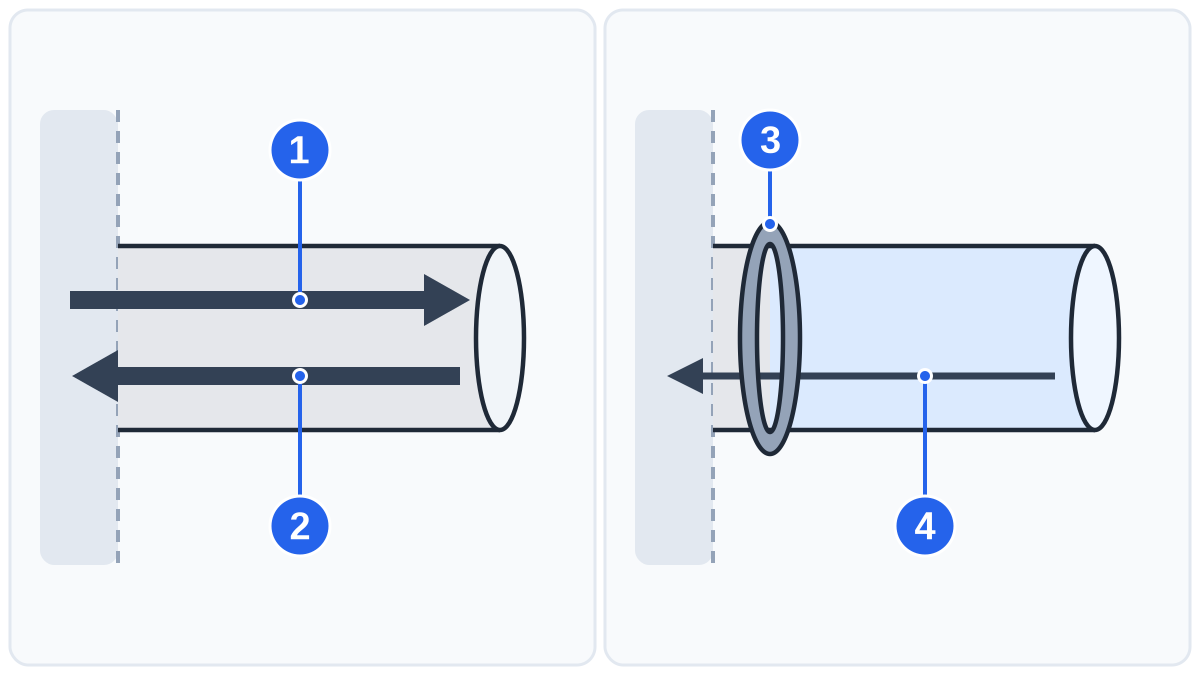
A ring works mainly on the way out. Sitting snugly at the base, it gently squeezes the veins that drain the penis, so blood leaves more slowly and the erection holds. The FDA puts it more formally: rings "restrict venous blood flow leaving the penis".
No ring: 1 blood in through the arteries, 2 blood out through the veins. With a ring: 3 the ring at the base, 4 a slower drain, so more blood stays in (shaded). Schematic, not to scale.
Holding blood in is also why rings have time limits. ISSM explains that while one is on, new blood can't flow in to bring the tissue oxygen, so a ring left on too long can permanently injure the penis.
What does a cock ring do, really?
Here's how the usual claims stack up against the research.
Claim
What the evidence says
Source
It keeps an erection firm
That's its purpose, especially for erections you can get but can't keep. The success figures we found are for rings used with vacuum pumps (see erection problems).
Not shown. In one small study, 42 men who usually ejaculated within a minute used a ring during sex for four weeks. Their median time went from 42 to 46 seconds, which wasn't a significant change.
No study we found shows that. FDA guidance leaves penis enlargement out of what these devices are for, and MedlinePlus says vacuum pumps, which use a ring, won't increase size over time.
It can, at least with pump bands. They may weaken ejaculation, and MedlinePlus says a band can stop semen coming out at climax, which it calls harmless.
On vibrating rings, my own experience adds a catch: even when a closed, non-adjustable ring fits perfectly, a vibrating one probably won't reach a partner. Our rundown of ring types has more on closed versus adjustable rings.
Cock rings and erection problems
This is the medical use. FDA guidance describes a ring on its own for erections you can get but can't keep, and a ring with a vacuum pump when getting one is the problem. The pump pulls blood into the penis, then a tension ring goes around the base to hold it there.
The NHS says pumps work for most men, and the European urology guideline cites success rates as high as 90% for erections good enough for sex.
What a ring can't do is fix the cause. The NHS says the odd off day is nothing to worry about. If problems keep happening, though, see a doctor or a sexual health clinic, because it might be a sign of a treatable condition such as high blood pressure or diabetes. FDA's labelling advice goes a step further and tells anyone with erection problems to see a doctor before using one of these devices, so a cause like diabetes isn't missed.
Side effects and risks in brief
With vacuum pumps, the American urology guideline says most side effects are minor and clear up without treatment. Still, keep an eye out for these:
Bruising and tiny purple spots. A ring can bruise or burst small blood vessels in the penis or scrotum, leaving the little spots doctors call petechiae (FDA; EAU).
Pain, numbness or a cold feeling. Pain and numbness are among the most common side effects with vacuum pumps and their rings (EAU), and a pump band can leave the penis cold to the touch. Whatever ring you're using, take it off right away if you notice any of them.
The usual limit is 30 minutes per use, with at least 60 minutes between uses. That comes from FDA's labelling advice for rings sold as medical devices, so treat it as a precaution, not a proven safe time. Our how-to covers how long you can wear one and the warning signs that mean it comes off now, plus what to do if it gets stuck.
Fit matters as well. FDA guidance says to use the least constrictive ring that keeps an erection, so it pays to find the right size.
Who should check with a doctor first
Rings are simple, but they aren't for everyone. FDA's labelling advice names three conditions a ring can make worse: Peyronie's disease (hardened tissue that can make the penis curve), priapism (long, usually painful erections not caused by arousal) and urethral stricture (a narrowed urethra that can make peeing hard). If you have any of them, talk to a doctor before trying one.
The same FDA advice adds two more for all of these devices. Don't use one if you have reduced pain sensation in the penis, because you might not notice it's hurting you, or if weak hands would make it hard to take off. That's written for medical devices, but we'd apply it to any ring, because the warning signs only help if you can feel them.
Bleeding disorders, blood thinners and sickle cell disease appear in the warnings for vacuum pumps, not rings. FDA guidance says not to use a pump with sickle cell disease or large amounts of aspirin or other blood thinners. The European urology guideline calls pumps "contraindicated" with bleeding disorders or anticoagulants, while the American one says to use them "with caution".
Rings can bruise too, though. Our inference, not an official rule: check with a doctor first if any of these applies to you.
And for everyone: an erection lasting more than 3 to 4 hours, or a painful one lasting more than an hour if you have sickle cell disease, is an emergency, even with the ring off. Go to an emergency department (A&E in the UK) or call your local emergency number, such as 911 in the US or 999 in the UK (NHS).
Cock ring questions
Do cock rings work?
For keeping an erection firm, medical sources say yes, though the success figures we found come from rings used with pumps. For lasting longer or getting bigger, the evidence is thin or missing (see the claims table above).
Do cock rings help you last longer?
There's no good evidence they do. In the one study we could find, men with very early ejaculation used a ring for four weeks and their timing barely moved.
Will a cock ring make my penis bigger?
Not that any study we found shows. MedlinePlus says the penis returns to its normal size once a pump band comes off. Rings are designed for firmness, not size.
What does a cock ring feel like?
Snug, like a firm band at the base. Beyond that it's personal, and we found no research on it. It shouldn't hurt. Pain, numbness or a cold feeling means it comes off right away (ISSM). Adjustable rings let you set the tightness yourself (SMSNA).
Is a cock ring a medical device or a sex toy?
Both exist. Constriction rings meant to help with erections fall into a US medical device category (21 CFR 876.5020), which doesn't settle the status of rings sold as sex toys.
Can a cock ring help with erectile dysfunction?
It can help you keep an erection, and when getting one is the problem, rings are paired with a vacuum pump (FDA). It won't treat the cause, so see a doctor or a sexual health clinic if problems keep happening.
Is a cock ring the same as a chastity cage?
No, they do opposite jobs. A chastity cage is built to limit erections, while a cock ring is worn to help keep one. The mix-up makes sense, because a cage attaches to a base ring that sits in roughly the same spot. Our own device, Veru One, sits there too: it detects erections and the raised heart rate near climax and alerts a keyholder in real time. For the cage side of things, start with our guide to the cock cage.