
A chastity cage is a lockable device worn over the penis that prevents a full erection and limits direct touch. It has two main parts: a ring that sits at the base of the penis, often behind the scrotum, and a tube or cage that encloses the penis. Adults wear one by choice, often with a partner holding the key.
A 2026 expert-opinion article in The Journal of Sexual Medicine describes these devices in the same basic terms: worn around the penis, often with a base ring behind the scrotum, and preventing full erections. It also notes that male chastity devices "have not been evaluated in clinical or epidemiologic studies". This guide therefore covers how the devices are built and used, and links medical sources for its safety advice.
Chastity cage meaning and related terms
"Chastity cage" refers to the device itself. You will also see these related terms:
- Chastity device: the broader term. It covers cages and also chastity belts, which are worn around the waist.
- Cock cage: a slang name for a chastity cage.
- Male chastity: the practice of wearing a chastity device, or otherwise agreeing to limit sexual activity. Here it means a consensual arrangement between adults, not a religious vow.
- Keyholder: the person who keeps the key. This is often a partner; some wearers keep their own key.
- Permanent chastity: a long-running arrangement. It should not mean that the device never comes off; see our permanent chastity guide.
How does a chastity cage work?
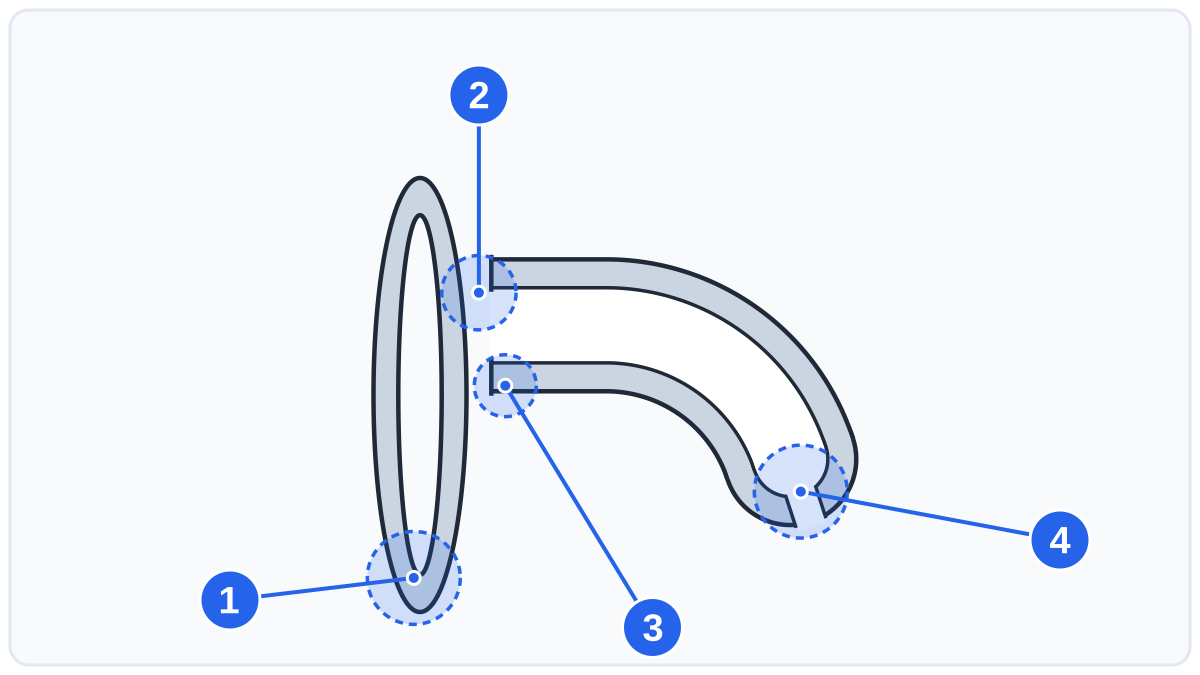
A typical chastity cage has four parts:
- Base ring: goes around the base of the penis, often behind the scrotum, and anchors the device. Its inner diameter is the main size choice.
- Cage or tube: encloses the penis. Its length and shape leave too little room for a full erection.
- Opening for urine: a hole or slot, usually at the tip, that lets urine pass without removing the device.
- Lock: a small padlock, a built-in lock or a numbered single-use plastic tag that holds the ring and cage together, usually through a locking pin.
The ring and cage are often separate pieces, and on some designs the gap between them can be changed with spacers. That gap matters: skin can get pinched in it, and a cage that sits too close to the ring or too far from it can press, rub or slip.
A cage limits what the body can do physically; it does not switch off arousal. According to the Journal of Sexual Medicine article, it prevents full erections and, for some users, makes ejaculation difficult or infrequent. For fitting steps, see how to put on a chastity cage.
Main types of chastity cage
Cages differ mainly in shape and material. The shape decides how the device sits against the body; the material decides its weight, its rigidity and how it is cleaned.
| Design | Shape | What to check |
|---|---|---|
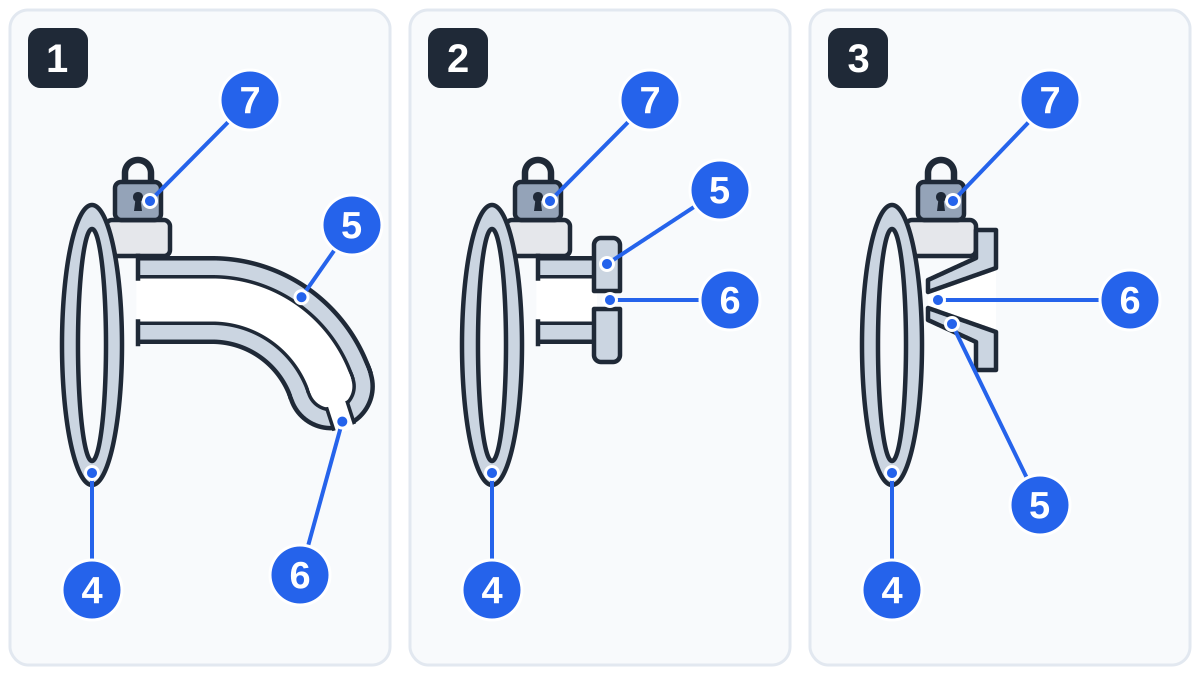
| Standard (curved) cage | A tube that extends forward and curves downward | Internal length and width, ring size, openings for air and rinsing |
| Flat cage | A short body with a flat front plate instead of a rounded tip | Pressure against the plate and where the opening sits |
| Inverted (inward) cage | A short tube that recedes toward the body instead of projecting outward | Inward pressure, access for cleaning and how urine drains |
| Short or "micro" cage | A very short tube | Usable internal length; a short cage is not the same as an inverted one |
| Open or closed | Bars or slots, or a mostly solid tube | Airflow and how easily the skin can be rinsed and dried |
Common materials are metal (such as stainless steel or titanium), hard plastic or resin, and silicone. Metal is heavier and rigid, plastic and resin are lighter, and silicone flexes. No material makes a device safe on its own, so follow the maker's cleaning instructions for the actual product. Our guide to the types of chastity cages compares designs and materials in more detail.
Why do people wear a chastity cage?
The Journal of Sexual Medicine article lists reasons "including but not limited to sexual satisfaction, consensual power exchange relationships, and gender affirmation for transgender and gender diverse individuals." In practice:
- Power exchange: one partner wears the cage and the other holds the key, so sexual release becomes something the couple negotiates. It can be part of orgasm control, sometimes called tease and denial.
- Personal interest: for some adults, the device or the restriction is a sexual interest in itself, with or without a partner.
- Gender affirmation: some transgender and gender-diverse people use one for this reason, according to the same article.
The benefits people describe come from personal accounts, not research. Whatever the reason, wearing a cage should be the wearer's informed choice, agreed in advance, with the freedom to stop at any time. Our guide to consent and boundaries in chastity play explains how couples set this up.
Chastity cage vs chastity belt
A chastity belt is worn around the waist and holds a front shield or tube in place; a chastity cage is held on mainly by its base ring. Belts are made for both men and women, while a cage is designed for a penis. See our chastity belt guide or the detailed comparison of cages and belts.
Is a chastity cage safe? Safety basics
There is no research-based answer yet. The Journal of Sexual Medicine authors write that male chastity devices have not been studied clinically. They point to research on ejaculation frequency and prostate health, and on testicle temperature, only as hypothetical ways in which prolonged wear could affect health. Nobody can say how long is safe, and this guide does not recommend a wearing time.
The closest medical evidence comes from case reports of metal rings worn at the base of the penis, the same position as a cage's base ring. A 2018 case review in Case Reports in Surgery warns that leaving a ring on "far longer than safely practiced" risks injury from lost blood flow (ischaemia) that can be permanent, and that early removal limits the damage. The authors add that embarrassment probably often delays people from seeking help. In a 2025 case report, a ring left on for more than 48 hours caused severe ischaemic injury and urinary retention; it had to be cut off with an angle grinder under anaesthesia, and the man left hospital after 28 days. He later recovered full function, an outcome the authors describe as rare. These reports involve rings, not cages, but they show why fit and quick removal matter.
Basic precautions:
- Fit: a ring that is too tight presses on the skin and blood vessels at the base, a cage that is too short presses on the tip, and a loose fit rubs and pinches. A device that is only bearable if you ignore discomfort does not fit.
- Removal: keep the key, or another way to open the lock, where the wearer can reach it at once, even when a partner is the keyholder.
- Hygiene: the NHS lists not washing the penis properly among the causes of balanitis (a sore, red, swollen head of the penis); its advice if you have balanitis is to wash every day with just water or an emollient and not to use soap or shower gel. Washing properly means taking the cage off: rinsing through the bars is not the same as washing and drying the skin. Clean the device itself as its maker instructs.
- Skin reactions: some metals, including nickel, can cause allergic contact dermatitis, which makes skin itchy, blistered, dry and cracked. If you know you react to nickel, ask the maker what a metal cage is made of.
Take the device off straight away if you notice pain, swelling, numbness or tingling, skin that turns cold, pale, blue or dark, broken skin, discharge or a bad smell. If it will not come off, if symptoms continue once it is off, or if you cannot pee, get urgent medical help at an emergency department (A&E in the UK) rather than forcing it.
Go to an emergency department or call your local emergency number (999 in the UK) straight away for sudden, severe pain in a testicle, which can be caused by a twisted testicle (testicular torsion) and can lead to the loss of the testicle if not treated quickly, and for testicle pain that lasts more than an hour. The same applies if the foreskin is pulled back and cannot go back over the end of the penis (paraphimosis).
For the full evidence, more warning signs and what is still unknown, read chastity cage risks and long-term effects.
ChastityTek is developing its own device, Veru One; it is not yet available to buy.
Frequently asked questions
Do chastity cages hurt?
A cage that fits should not hurt. An erection pressing against the cage can be uncomfortable, but pain, numbness, swelling or a change in skin colour are signs to take it off. Repeated discomfort means the device does not suit you; it is not something to get used to.
How long can you wear a chastity cage?
No safe limit has been established, because chastity devices have not been studied clinically, and a fixed wearing schedule is not based on evidence. The device has to come off for washing and skin checks, and at once if warning signs appear. Our risks guide sets out what is known and unknown.
Can a chastity cage cause permanent damage?
A device that cuts off blood flow can. Case reports of metal rings worn at the base of the penis describe ischaemic injury that may become permanent without prompt removal. There are no long-term studies of cage wear itself, so the long-term risk of a well-fitting cage is unknown, not proven to be zero.
Can you pee while wearing a chastity cage?
Yes. Most cages have an opening at the tip for this. Rinse and dry the area afterwards. Difficulty peeing, or pain when peeing, is a reason to remove the device. Our guide to using the toilet in chastity has practical detail.
Can you wear a chastity cage under clothes?
That depends on the device, your body and your clothes. Smaller and flatter designs show less under fitted clothing. See our guide to wearing a chastity cage under clothes.