Thrusting Sex Toys: How They Work, Types and Safety
What a thrusting sex toy does, how thrusting differs from vibration, the main designs for you or a partner, and what to check before you buy one.
A thrusting sex toy moves back and forth along its length on its own, instead of just buzzing in place. You pick the speed and the toy does the pushing, so your wrist can sit this one out.
Most people picture a thrusting vibrator or dildo, but there are thrusting prostate toys and strokers too, so this could be a toy for you or a partner. Shopping around? Our main guide covers other sex toys.
How thrusting works
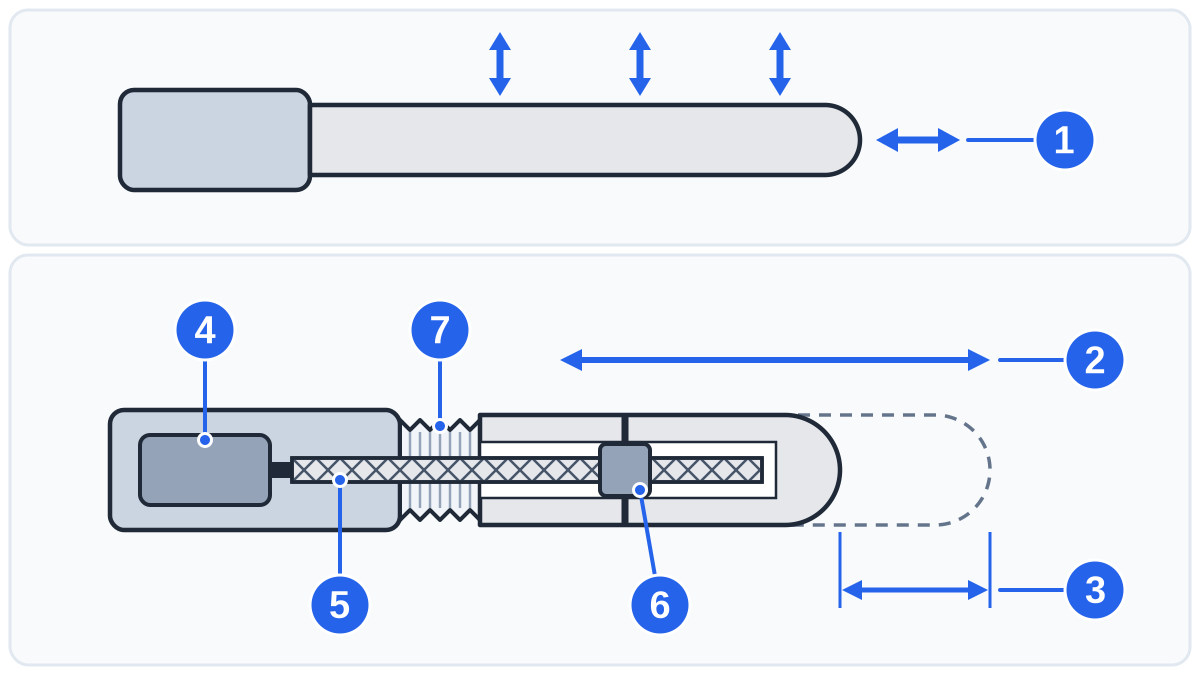
Vibration and thrust are both back-and-forth movement. The difference is scale. Vibration is a tiny, fast shake: the two vibrators measured in a 1994 clinical study both ran at 100 cycles a second (100 Hz) and moved just 1 or 2.5 mm end to end, depending on the model.
Thrust is the big, slow version. One thrusting-vibrator patent describes the toy changing length by about 20 to 100 mm, with each full stroke taking roughly half a second to two seconds (US 11,077,014).
1 vibration, 2 thrust, 3 stroke distance, 4 motor, 5 screw with a criss-cross groove, 6 nut carrying the moving front, 7 stretchy tube. Simplified from patent descriptions. Schematic, not to scale.
Toy motors generally spin, so a thruster has to turn spin into push and pull. A 2025 patent lists the classic tricks, a cam or a rod pushed and pulled by a spinning wheel, and their weak spots, such as limited stroke length and weak drive force in portable toys (US 12,201,577).
The patent's own design, roughly as drawn above, has the motor in the handle turning a screw. A nut on the screw carries the toy's front, and a stretchy tube of silicone or soft bellows covers the gap.
The cleverest bit is the groove. Patents describe screws cut with a left-hand and a right-hand spiral joined at the ends, so whatever rides the groove runs out and back while the motor keeps turning one way (US 10,561,572; US 11,077,014).
In the first patent, the screw's length sets the stroke. The second also describes reversing the motor at set points of about 25, 51 and 76 mm.
Preset patterns look great on the box (one thrusting stroker's manual lists 7 thrusting and rotating modes), but they're maker claims that tell you far less than stroke length and speed.
Types of thrusting sex toys
The table sticks to maker manuals and patents, and says "check the manual" where those run out. Nothing here is tested or ranked.
Type
What moves
Where it's used
Power
Typical material
Cleaning
Thrusting vibrators and dildos
The shaft or tip pushes out and back, in some designs with vibration too
Inside the vagina, or the anus if it has a flared base
Rechargeable battery
Silicone over a hard plastic body
The whole toy, if its water rating allows
Dual-stimulation thrusters
A thrusting shaft plus an external arm; LELO's INA Thrust has separate buttons for each
Size and insertable length. Overall length flatters. Insertable length is what counts, and LELO, for example, lists 110 mm for the INA Thrust.
Stroke distance and speed. Look for a stated stroke length and strokes per minute (or Hz), and don't assume the stroke adjusts: in one patent's design, the screw's length fixes it. No numbers anywhere? Ask before you buy.
Power and noise. Check battery life and charging time (LELO quotes up to 2 hours for each), and look for a stated noise level.
Material. Be wary of anything sold as "jelly". A 2006 Danish government survey found it was plasticised PVC, and in a small 2023 study, a toy labelled "phthalate-free" turned out not to be. ISO 3533 covers sex-toy material and design safety, but a maker saying it complies is still a claim. Our materials guide has more.
Base, handle or suction cup. This decides how you hold the toy, or if you need to at all. For anal use, a flared base or other way to pull it out isn't optional.
Controls. Buttons are fine solo, while a remote or app lets a partner take over. If it pairs with an app, read our privacy checklist first.
Water rating. In the IP code, a second digit of 7 means rated for temporary immersion between 0.15 and 1 m of water (IEC 60529). LELO's INA Thrust is IPX7, while the Warrior stroker is listed as IPX0. Check before bath time.
Using one with a partner or by remote
A thruster is easy to share because the toy does the work, and with a suction cup nobody has to hold it. Agree on a speed and a stop word first, and give the controls to whoever's on the receiving end. Our couples toys guide has more ideas.
Some thrusters pair with a phone app over Bluetooth. LELO's manual walks through the pairing, and then whoever holds the phone holds the controls. Our remote control guide covers how far that reaches.
Start slow, and if anything hurts, stop. The Warrior manual says to discontinue use at any discomfort.
Anything that goes in the anus needs a flared base, meaning wider at the bottom, or some other way to pull it out, so it can't slip all the way in. Use lots of lube there, because the anus doesn't lubricate itself. If a toy does go all the way in, get medical help straight away to have it removed.
Clean it the way the instructions say, as Planned Parenthood advises. LELO's waterproof thruster gets warm water and antibacterial soap, and never cleaners with alcohol, petrol or acetone. On a stroker, the sleeve comes out and is washed on its own.
Distance and speed. Vibration shakes a millimetre or two, very fast. Thrust travels centimetres, far more slowly. Some toys do both: in one patent's design, the moving front can carry a vibrating motor (US 12,201,577).
Are there thrusting toys for men?
Yes: thrusting strokers for the penis, and thrusting prostate toys. Strokers get the full treatment in our automatic masturbators guide.
Handheld or machine?
The handhelds in the manuals we've linked are rechargeable, and LELO's is fully waterproof. A machine is free-standing, so read its manual for power and setup before you buy.
Which lube?
Water-based, and be generous: LELO's manual suggests a liberal amount of its own lube, before and during use. Skip silicone lube on silicone toys unless the maker okays it.
How loud are they?
Check the maker's figure: LELO lists under 63 dB at its loudest for the INA Thrust. For scale, NIDCD, the US hearing institute, puts normal conversation at 60 to 70 dBA, though LELO doesn't say how it measured. No figure? Reviews that mention noise will have to do.
Can couples use one?
Yes. Either of you can hold it, or a remote or app puts one partner in charge. Sharing it? Use a fresh condom every time.
From ChastityTek · our device
It knows when you're close.
Veru One is a biometric chastity device that alerts your keyholder in real time when you get close or take it off.