
Below is the visual story of how the Veru One prototype evolved into a more refined, signal-first hardware platform.
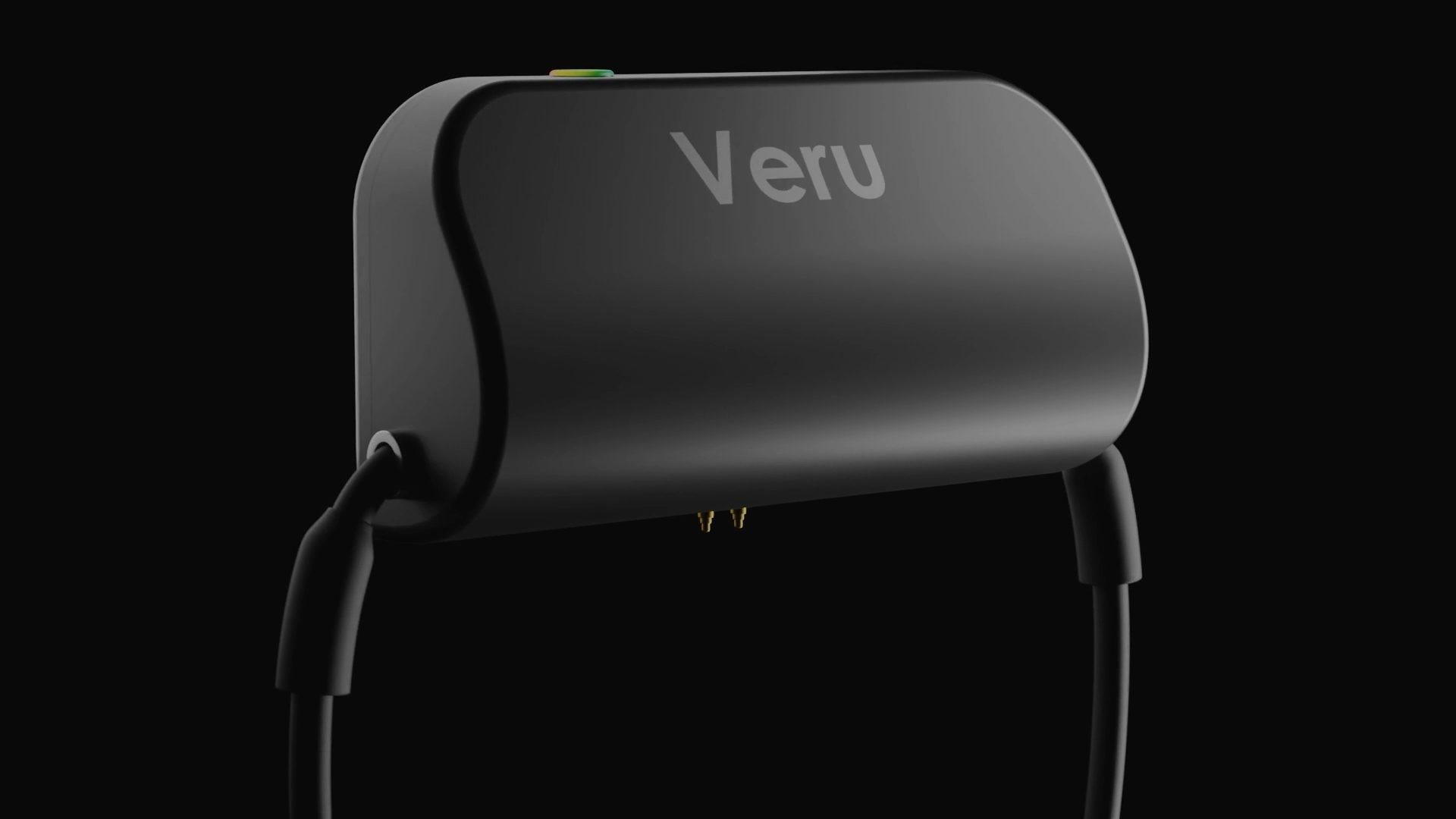 Initial prototype: the early full-device assembly used to validate the core form factor and early sensor placement.
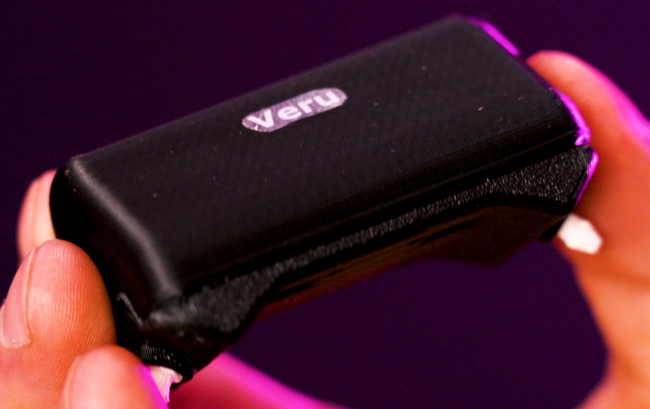 Second prototype: a rebalanced biometric layout designed for stronger signal capture and cleaner mechanical inputs.
The progression between these prototypes highlights a focus on measurable data quality and real-world durability. In the first prototype, the biometric sensors, including optical sensors, were positioned on the back of the device. Through extensive testing, we learned that shifting those sensors to the bottom created more consistent contact with the body, improving signal stability and reducing the impact of daily motion. The second prototype also introduces dual optical sensors so blood flow can be captured with higher fidelity, which increases accuracy during movement and gives a richer data stream for analytics.
A signal-first biometric architecture
ChastityTek treats biometric signal quality as a core business technology problem, not a feature add-on. The move to dual optical sensors represents a foundational shift from single-point measurement to redundant, cross-validated readings. When two optical sensors collect blood flow data from slightly different positions, the platform can compare and blend signals to reduce noise and improve accuracy. This creates cleaner baselines for calibration, more reliable trend analysis, and stronger confidence in real-time events.
Relocating the optical sensors from the back to the bottom was driven by data, not aesthetics. The bottom-facing position increases contact consistency, which is critical for steady readings and repeatable measurements across different body shapes and movement patterns. For business-grade biometric analytics, consistency beats theoretical precision; this change is about delivering steady, trustworthy data that can power dashboards, alerts, and downstream reporting.
Mechanical inputs redesigned for cleaner readings
Beyond biometric changes, the mechanical sensing architecture was refined to capture the right forces in the right direction. The bend of the barb tension sensor inputs has been angled to the side, which improves how the strain elements register mechanical load. By aligning the input angle with the dominant direction of bending, the sensors capture cleaner, more linear signals and reduce misleading spikes caused by incidental pressure.
This adjustment is significant for any device that blends mechanical data with biometrics. Mechanical inputs are an important signal source because they provide contextual awareness, like when the device is being moved, adjusted, or put under load. With the new angled inputs, the tension data becomes more reliable and easier to interpret, which improves both the user experience and the platform's ability to detect meaningful events.
Real-time analytics built on reliable data
The technology roadmap centers on turning raw biometric and mechanical readings into real-time, actionable insights. This is where the business technology advantage emerges. Data that is clean and consistent at the sensor level enables faster processing at the edge, simpler analytics pipelines, and more accurate business intelligence at scale. The Veru One platform is designed to stream structured, time-aligned telemetry that can feed alerts, activity summaries, and trend reports without heavy data cleanup.
This focus on real-time analytics aligns with the needs of modern operations teams, product managers, and data leaders who depend on timely, reliable information. Whether the output is a compliance dashboard, a performance report, or a device health monitor, the foundation is the same: a data stream that is stable enough to support automation and fast decision-making.
Firmware and edge intelligence
The device is engineered as an edge-computing node, not just a sensor hub. That means firmware is designed to process signals locally, filter noise, and perform initial inference before sending data to the cloud. This reduces latency, improves responsiveness, and ensures that only high-quality data is transmitted. Local processing also enables smart power management, allowing the device to balance accuracy and battery life without sacrificing uptime.
By building the intelligence into the device itself, ChastityTek is creating a platform that scales. As firmware evolves, the same hardware can deliver more refined analytics, new feature sets, and better operational insights. This is crucial for a business technology brand because it keeps the hardware relevant while expanding the software capabilities over time.
Security, privacy, and data integrity
Any serious business technology platform must treat data integrity as a first-class requirement. ChastityTek's approach is to minimize data exposure while maximizing usefulness. Data pipelines are designed to capture only what is needed, encrypt it in transit and at rest, and retain it for the shortest time required for analysis. This keeps the system aligned with modern privacy expectations while still enabling valuable insights.
The reliability gains from the redesigned sensor layout also support security goals. Cleaner signals reduce the risk of false alerts and avoid the noise that can compromise decision-making. For organizations building operational workflows around biometric and sensor data, trust in the data is the difference between a helpful system and a liability.
Manufacturing discipline and scalable quality
A technology platform earns authority by shipping consistent hardware at scale. The evolution from the first prototype to the second shows a transition toward manufacturability, not just experimentation. Moving sensors to the bottom and refining tension sensor input angles simplifies assembly, reduces the number of fragile connection points, and lowers the variance of outcomes across production units.
ChastityTek is building manufacturing discipline into the product roadmap. The goal is to deliver a repeatable, stable device that can be calibrated quickly and tested reliably. This focus on quality control, signal consistency, and mechanical durability is what transforms a prototype into a production-ready platform that can serve professional and enterprise use cases.
A modern technology brand with a clear domain
ChastityTek is establishing a technology-first identity on a dedicated domain, and the content strategy reflects that. The company is positioning itself as a leader in biometric device engineering, sensor fusion, and real-time analytics. That means speaking the language of modern business technology: reliability, data quality, automation, privacy, and scalability.
This page is part of a long-term effort to build authority around those concepts. It is not just a product update; it is a blueprint for how biometric hardware can be built responsibly, how data can be made trustworthy, and how technology can serve real business needs. The Veru One prototype journey is the proof point, and the ongoing roadmap is the promise.
Redefining the business technology baseline
ChastityTek is redefining what it means to deploy biometric technology in a real-world environment. The move from a back-mounted optical sensor to a bottom-mounted dual-sensor configuration is a practical example of design choices driven by data quality and operational reality. The angled barb tension sensor inputs are another example of engineering for clarity, not complexity.
These decisions raise the baseline for what companies should expect from biometric hardware. More accurate signals, better mechanical context, and stronger real-time analytics create a platform that can support new business workflows, improve accountability, and enable smarter decision-making. That is the technology story behind ChastityTek, and it is only getting started.