
BDSM Education • Orgasm Control • Consent & Safety
What Is a Forced Orgasm in Consensual BDSM?
“Forced orgasm” can sound alarming if you only hear it outside of kink context. In consensual BDSM, it refers to a negotiated power-exchange experience where one partner guides stimulation and the other intentionally surrenders control—within clear boundaries, safewords, and care. This guide keeps the focus where it belongs: consent, safety, and the psychology of orgasm control.

Consent note: This article uses “forced orgasm” strictly in the consensual BDSM sense. If you’re researching this term because of coercion or assault, you deserve support— and a physiological response never implies consent.
Forced orgasm in BDSM is about consent-first intensity—trust, not coercion.
Table of contents
- Meaning: what “forced orgasm” actually means in BDSM
- Why people want it: psychology and power exchange
- What’s happening in your body: arousal, overwhelm, and “subspace”
- Consent & safety essentials (limits, safewords, check-ins)
- Anatomy differences: refractory periods and pacing
- Aftercare: preventing sub-drop and closing the loop
- Where Veru One fits: orgasm control beyond one scene
- Veru One Q&A
Meaning: what “forced orgasm” actually means in BDSM
In everyday language, “forced” implies violation. In consensual BDSM, it’s an erotic shorthand for an experience that feels overwhelming or inescapable—because the receiver has chosen to surrender control within a negotiated scene. The dominant partner orchestrates the pace and intensity; the submissive agrees to be guided, restrained, teased, or pushed—within agreed limits.
That distinction matters. Consent is not a vibe; it’s an explicit agreement with real stop mechanisms. Ethical kink frameworks like SSC (Safe, Sane, Consensual) and RACK (Risk-Aware Consensual Kink) exist because intense play can be physically and emotionally demanding. “Forced orgasm” is only “forced” in the roleplay sense—never in the rights-and-safety sense.
Why people want it: psychology and power exchange
The draw usually isn’t just the orgasm. It’s the hand-off of control . Many people find deep relief in not having to steer the encounter—no pacing, no performing, no “doing it right.” When the receiver can stop managing and simply experience, pleasure can feel bigger and more honest.
There’s also a trust component that couples often describe as intensely bonding. Letting someone else hold the “keys” to your nervous system (even temporarily) requires vulnerability. When that power is held carefully—attentive check-ins, respect for limits, and thoughtful aftercare—people often report a closeness that feels different than standard, egalitarian sex.
Finally, forced orgasm play can slot into many fantasy “archetypes” without needing explicit scripts: playful resistance, endurance challenges, service dynamics, or “I decide when you’re allowed to finish.” The common thread is not humiliation or cruelty—it’s intentional structure around surrender.
What’s happening in your body: arousal, overwhelm, and “subspace”
Intensity changes the brain. Prolonged stimulation, restraint, and anticipation can trigger a potent mix of neurochemicals—endorphins (soothing, floaty), dopamine (reward), and oxytocin (bonding). Many kink communities call the resulting altered state subspace : a trance-like, time-dilated, euphoric focus where the “thinking mind” gets quieter.
One theory used to explain that quieting is “transient hypofrontality”—the idea that under heavy sensory load, the brain temporarily reduces higher-order executive processing so you can stay present in the body. In practical terms, it can feel like dropping out of your head and into sensation.
That same intensity can also cross into sensory overload . Some people—especially those who are neurodivergent or simply more sensory-sensitive—may hit overwhelm faster. The goal isn’t to “break” anyone; it’s to calibrate intensity so it stays thrilling, not destabilizing. Slow ramps, frequent check-ins, and truly respected stop signals keep this kind of play healthy.
Consent & safety essentials (limits, safewords, check-ins)
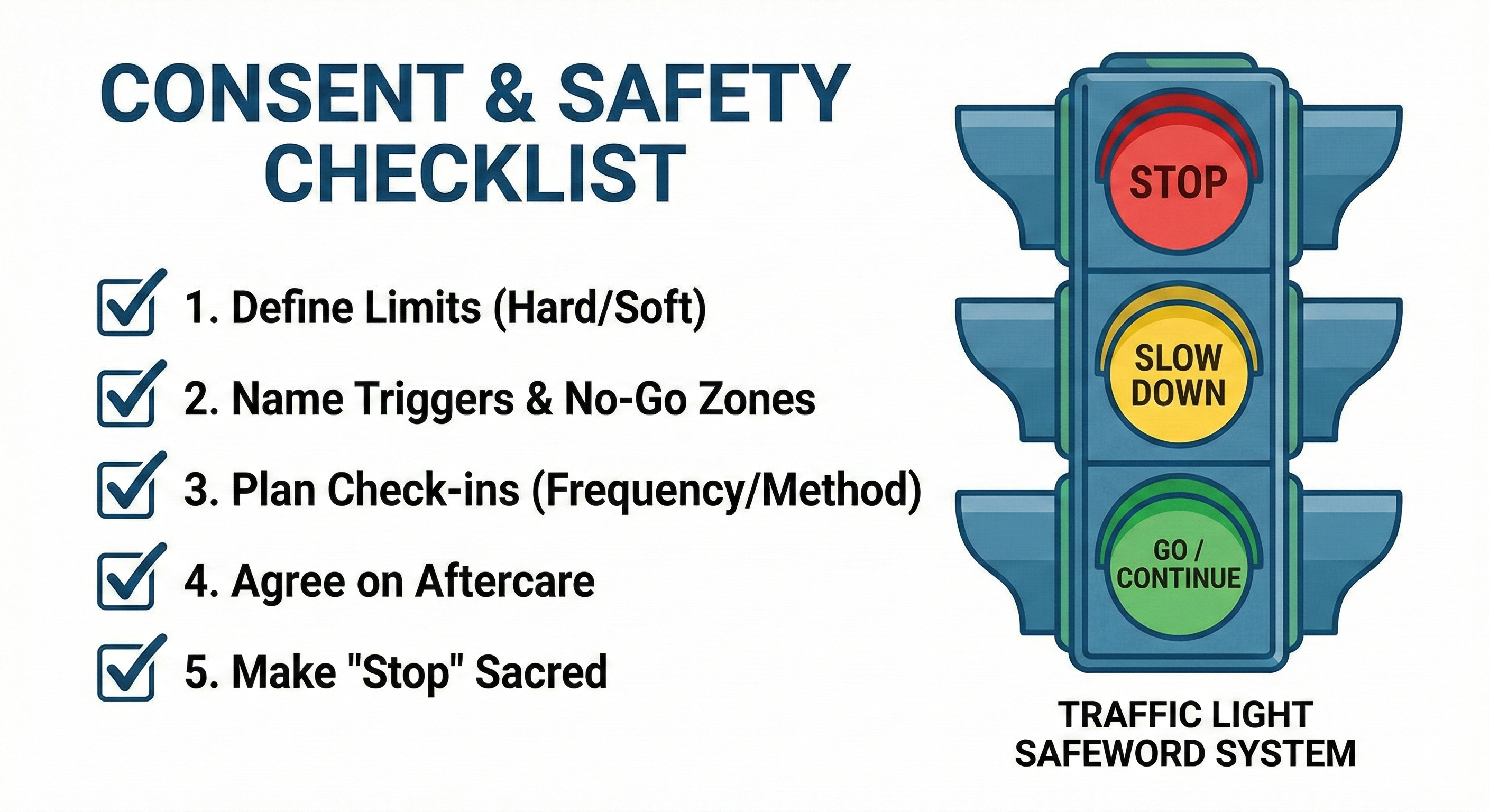
If you remember one thing: forced orgasm play should be more negotiated than standard sex, not less. Here’s a consent-first baseline that scales from beginner to advanced:
- Define limits. Hard limits (never) and soft limits (maybe, with care). Name triggers, medical concerns, and “no-go” zones like numbness, sharp pain, panic, or dizziness.
- Pick a safeword system. The “traffic light” model is popular: Green (keep going), Yellow (slow down / check), Red (stop immediately). If speech might be hard, add a nonverbal stop signal (dropping an object, tapping).
- Plan check-ins. Even a short “Color?” or “Number 1–10?” at set intervals can prevent accidental escalation.
- Agree on aftercare. Don’t treat it as optional. Intensity has a physiological “come-down.”
- Make “stop” sacred. No sulking, no punishment, no debate. Stopping is success, because it proves trust.
A simple way to think about intensity: negotiate first, communicate during, and care after.
Anatomy differences: refractory periods and pacing
Bodies differ. Some people can experience multiple orgasms with little recovery time; others have a more pronounced refractory period where additional stimulation can quickly turn unpleasant. This is why “forced orgasm” doesn’t look the same for everyone: pacing, pauses, and expectations should match the receiver’s body.
In practice, many couples build forced orgasm scenes around control (who decides when climax happens), not necessarily around “how many.” For some, the most intense part is the anticipation : extended build-up, near-finish moments, and the mental surrender of “I don’t get to choose the ending.”
Aftercare: preventing sub-drop and closing the loop
Intense scenes can cause a real neurochemical crash afterward—often called sub-drop . It can show up as shakiness, sadness, irritability, exhaustion, or an emotional “why do I feel weird?” the next day. This doesn’t mean anything went wrong; it means your body went from high activation to low.
Helpful aftercare is usually simple: water, a snack, warmth, quiet, reassurance, and gentle reconnection. Many partners also do a brief debrief: what was amazing, what was too much, what should change next time. A quick check-in 24–48 hours later can be surprisingly powerful, especially if one partner tends to get delayed sub-drop.
Where Veru One fits: orgasm control beyond one scene
Forced orgasm play often lives inside a bigger theme: orgasm control . For many couples, the most satisfying version isn’t random intensity—it’s a story arc: anticipation, denial, earned release, and a shared sense of “we did that together.”
That’s where a keyholding dynamic can add structure. A chastity device can help keep the rules real outside the bedroom: fewer impulsive releases, less “willpower theater,” and more intentionality. Instead of chasing intensity, you build tension over time—then choose the moment of release together.
Veru One is designed around that real-life use case: comfort, discretion, and a consent-first approach to control. It’s not about forcing anything. It’s about making agreements easier to keep—and making the eventual “yes” feel more meaningful.
Veru One Q&A
What is the Veru One?
Veru One is a comfort-focused, discreet male chastity concept intended for long-wear keyholding and orgasm control—built for couples who want structure without making daily life miserable.
Is Veru One about non-consensual control?
No. Veru One is meant to support mutual agreements —the kind you negotiate, revise, and can pause anytime. Consent is always ongoing, and communication always wins over “rules.”
How does Veru One relate to forced orgasm BDSM play?
Many couples enjoy a “denial → build-up → release” rhythm. A device can help maintain denial during everyday life so that a planned release scene—whether gentle or intense—feels intentional and earned.
Is it private?
Privacy is a core expectation for most people exploring orgasm control. Veru One is designed with discretion in mind so your dynamic stays yours—confidential and relationship-centered.
Where should we start if we’re new?
Start with negotiation, a safeword system, and low-intensity experiments. Focus on trust and communication first; intensity is optional. If anything feels emotionally “sticky” afterward, treat that as a signal to slow down and add aftercare, not a reason to push harder.
Next step: If orgasm control interests you, consider starting with a simple agreement: a time window, clear rules, and a check-in schedule. When you’re ready, Veru One can be the tool that helps that agreement actually stick.
Veru One and This Topic
For forced-orgasm dynamics, long-term success comes from consent architecture, not scene intensity.

Use the email signup form below this page for launch updates and availability notifications.